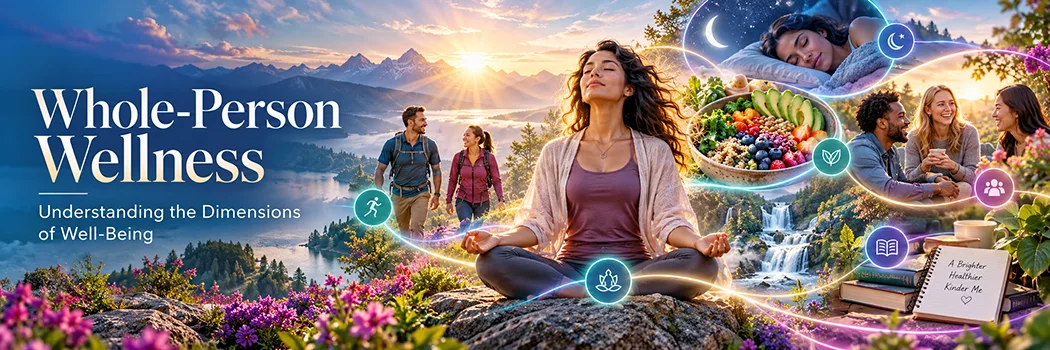
Wellness is often discussed one piece at a time. We talk about exercise, nutrition, sleep, stress, mental health, relationships, or personal growth as though each exists in its own separate category. In everyday life, however, these parts constantly influence one another.
A difficult night of sleep can affect mood, concentration, appetite, and motivation to exercise. Persistent stress can influence sleep and relationships. Regular physical activity can support physical health while also benefiting mood and brain health. Supportive relationships may make difficult periods easier to navigate. A greater sense of purpose can provide motivation to remain engaged, active, and connected.
Whole-person wellness begins with recognizing these connections.
Rather than asking only, “What part of me needs attention?” it encourages a broader question:
“What is happening across my life that may be influencing how I feel, function, and grow?”
That shift—from isolated concerns to interconnected well-being—is central to the philosophy of Mind Body Works.
What Does Whole-Person Wellness Mean?
Whole-person wellness is an approach to well-being that considers the many dimensions of a person’s life together rather than viewing physical health, mental health, behavior, relationships, and environment as completely separate.
The concept parallels the growing scientific interest in whole-person health. The National Center for Complementary and Integrative Health, part of the National Institutes of Health, defines whole-person health as looking beyond individual organs and body systems to consider interconnected biological, behavioral, social, and environmental factors that can promote health or contribute to disease. The approach emphasizes health promotion, resilience, prevention, and restoration across the lifespan. NCCIH
Whole-person wellness takes that concept into everyday life.
It does not suggest that every problem has a lifestyle solution, nor does it replace medical or mental-health care. Instead, it recognizes that well-being develops within a larger context that includes how we move, eat, sleep, think, recover, connect with others, experience our surroundings, and find meaning in our lives.
There is no single universally accepted list of “wellness dimensions,” and that is important. Human well-being does not divide neatly into boxes. The dimensions below are better understood as overlapping areas of life that help us see the larger picture.
1. Physical Well-Being: Supporting the Body We Live In
Physical well-being is perhaps the most familiar dimension of wellness, but it involves much more than appearance, body weight, or athletic performance.
It includes movement, strength, mobility, cardiovascular health, nutrition, sleep, recovery, preventive care, and the ability to perform the activities that make everyday life possible.
Regular physical activity illustrates how quickly one dimension can extend into others. WHO reports that physical activity provides substantial physical and mental-health benefits, contributes to the prevention and management of several major noncommunicable diseases, reduces symptoms of depression and anxiety, and supports brain health and overall well-being. World Health Organization
Nutrition works similarly. A healthy diet supports growth, physiological function, active living, and prevention of nutrient deficiencies and several diet-related diseases. Importantly, WHO emphasizes that healthy diets are not identical for everyone; they vary with age, activity, culture, available foods, preferences, and other individual circumstances. World Health Organization
Whole-person wellness therefore asks something broader than “Am I exercising?”
It asks whether the body is being given the movement, nourishment, rest, recovery, and appropriate healthcare it needs to function well.
2. Mental and Emotional Well-Being: Understanding Our Inner Experience
Mental wellness does not mean feeling happy all the time.
Human beings experience worry, disappointment, frustration, grief, uncertainty, and periods of emotional strain. Mental and emotional well-being is better understood as the capacity to recognize and respond to our internal experiences, regulate emotions, adapt to challenges, maintain perspective, and seek help when necessary.
This dimension can include:
- Emotional awareness and regulation
- Resilience and adaptability
- Stress-management skills
- Self-compassion and realistic self-talk
- Attention and mindfulness
- Healthy coping strategies
- Recognizing when professional support is appropriate
Mental and physical well-being are not independent systems. NCCIH’s whole-person framework specifically emphasizes connections among psychological, behavioral, nutritional, physical, social, and environmental influences rather than treating each health concern in isolation. NCCIH
That is why caring for mental well-being belongs at the center—not the margins—of whole-person wellness.
3. Rest, Stress, and Recovery: Creating Space to Restore
Modern life often celebrates activity but underestimates recovery.
Yet the body and mind cannot remain continuously activated without consequences. Sleep, relaxation, downtime, and recovery give biological and psychological systems opportunities to reset and restore.
NCCIH specifically identifies poor sleep and chronic stress among behavioral factors that can influence the movement of health toward disease, while stress management and healthier lifestyle behaviors are part of the broader whole-person approach to restoring and maintaining health. NCCIH
Recovery does not necessarily mean doing nothing. It may involve quality sleep, a quiet walk, time in nature, meditation, breathing practices, enjoyable hobbies, social time, or simply creating periods during which demands decrease.
An important question for whole-person wellness is therefore not only:
“What am I accomplishing?”
but also:
“Am I allowing myself enough opportunity to recover from what life requires of me?”
4. Social Well-Being: Connection, Belonging, and Relationships
Wellness is sometimes presented as an individual pursuit: my workout, my diet, my meditation practice.
But human beings are profoundly social.
Relationships can provide companionship, encouragement, belonging, practical assistance, emotional support, and opportunities to give as well as receive. The U.S. Surgeon General’s work on social connection describes connection as an important contributor to individual and community health, while social isolation and loneliness are associated with significant health risks. HHS.gov
Social wellness does not require having a large circle of friends. Quality matters.
It may involve maintaining close relationships, participating in a community, reconnecting with someone important, volunteering, joining an activity group, sharing meals, asking for help, or simply making time for meaningful conversation.
Whole-person wellness recognizes that sometimes one of the healthiest things we can do is not do something alone.
5. Purpose, Learning, and Personal Growth: Having Something to Move Toward
Human well-being is not only about avoiding illness or discomfort. People also need opportunities to learn, contribute, create, pursue goals, and experience a sense that life has direction and meaning.
A sense of purpose is generally understood as having meaningful goals, direction, and motivation. Research in older adults has repeatedly associated greater purpose with positive aspects of health and well-being, although these associations do not prove that purpose alone causes better health. PubMed
The National Institute on Aging also notes that meaningful and socially engaging activities—such as volunteering, hobbies, classes, and community involvement—can support well-being and independence as people age. National Institute on Aging
Personal growth may look different at different stages of life.
It can mean:
- Learning something unfamiliar
- Developing a new skill
- Becoming more adaptable
- Building confidence through experience
- Creating something
- Mentoring someone
- Volunteering
- Revisiting old interests
- Setting a meaningful goal
- Remaining curious about the world
There is no age at which growth must stop.
Whole-person wellness includes not only caring for who we are today, but continuing to develop who we can become.
6. Environmental Well-Being: Recognizing That Wellness Happens Somewhere
Health does not occur in a vacuum.
The places in which people live, work, learn, travel, and socialize can make healthy choices easier—or considerably more difficult.
Access to safe housing, nutritious food, green space, transportation, education, employment opportunities, clean air, safe neighborhoods, and healthcare all influence well-being. WHO’s 2025 report on social determinants of health equity emphasizes that the conditions in which people are born, grow, live, work, and age can have profound effects on health outcomes. World Health Organization
This matters because whole-person wellness should never become a philosophy of blame.
It would be unrealistic to tell people simply to “make better choices” while ignoring whether their circumstances provide reasonable opportunities to make those choices.
Environmental wellness also operates on a smaller personal scale.
Our immediate surroundings can influence behavior. A bedroom designed for sleep, food kept conveniently available for healthy meals, a comfortable place to exercise, access to sunlight or nature, and fewer unnecessary distractions can all help shape daily routines.
Sometimes changing the environment is more effective than relying on willpower alone.
7. Informed Self-Care and Healthcare: Knowing When Each Is Needed
Whole-person wellness places considerable value on self-care—but self-care and healthcare are not competitors.
Exercise cannot replace emergency treatment. Meditation is not a substitute for appropriate treatment of serious mental illness. Nutrition cannot replace every medication. A wellness practice should not be used to delay diagnosis of concerning symptoms.
At the same time, medical care does not perform every function required for a healthy life.
A clinician may treat hypertension, but daily movement, food choices, sleep, stress, and adherence to treatment happen outside the examination room. A physical therapist may restore function, but continued movement happens afterward. A mental-health professional may provide treatment and tools, but relationships, routines, recovery, and everyday environments remain part of the larger picture.
Integrative health reflects this complementary perspective by combining appropriate conventional care with evidence-supported complementary approaches while focusing on the whole person rather than a single organ system. NCCIH
Whole-person wellness therefore encourages two forms of responsibility:
Participate actively in your own well-being—and recognize when professional expertise is needed.
The Dimensions Are Connected, Not Separate
The real value of whole-person wellness appears when we stop treating these dimensions like independent compartments.
Consider a simple example.
A person begins sleeping poorly because of prolonged stress. Fatigue makes exercise less appealing. Reduced movement affects energy and mood. Irritability begins straining relationships. Less social interaction increases feelings of isolation. Motivation declines, making it more difficult to prepare nourishing meals or pursue meaningful activities.
No single event caused the entire situation.
The dimensions interacted.
But that also means improvement can sometimes travel through the system in the opposite direction.
A daily walk may provide movement, outdoor light, stress relief, and social interaction when taken with a friend. Better sleep may improve energy and make exercise easier. Joining a class may provide learning, purpose, routine, and connection simultaneously.
One positive change can sometimes support several dimensions at once.
This is one of the most useful ideas in whole-person wellness.
Wellness Does Not Mean Perfect Balance
The familiar image of wellness as perfectly balancing every area of life can create unrealistic expectations.
Life is dynamic.
There may be periods when family responsibilities require more attention, times when physical recovery becomes the priority, seasons devoted to professional work, or moments when emotional healing needs to come before ambitious personal goals.
Whole-person wellness does not require giving equal attention to everything every day.
A better goal is awareness and responsiveness.
We can notice when an important dimension has been neglected and make reasonable adjustments. Balance may therefore be better understood not as a fixed state, but as an ongoing process of recalibration.
Sometimes wellness means adding something.
Sometimes it means reducing something.
Sometimes it means asking for help.
And sometimes it simply means recognizing that circumstances have changed and our routines need to change with them.
A Practical Whole-Person Wellness Check-In
Whole-person wellness becomes useful when it helps us look at our lives more clearly.
Occasionally, consider asking yourself:
- How does my body feel, move, and recover?
- Am I consistently nourishing myself in ways that support my health?
- Am I getting enough restorative sleep?
- How am I responding to stress?
- Do I have people with whom I feel genuinely connected?
- Am I continuing to learn, create, or pursue meaningful goals?
- Does my environment support—or interfere with—the habits I want to build?
- Is there something I have been trying to manage alone that deserves professional help?
- What part of my well-being currently needs more attention?
- What is one realistic action that could improve more than one area of my life?
The purpose is not to produce a wellness score.
It is to identify patterns.
Whole-Person Wellness Is Personal
Although the dimensions are broadly relevant, the way they appear in an individual’s life will differ enormously.
For one person, wellness may mean rebuilding strength after illness.
For another, it may mean learning to manage stress without sacrificing sleep.
Someone else may need greater social connection after retirement, more movement during a sedentary workday, a healthier relationship with food, renewed intellectual challenge, or a stronger sense of purpose.
Age, culture, health status, resources, responsibilities, abilities, preferences, and life circumstances all matter.
That is why there can be no single perfect wellness routine.
Even research on whole-person health increasingly recognizes the difficulty of measuring health through isolated markers alone. In 2025, NCCIH introduced a Whole Person Health Index designed to help researchers and healthcare professionals capture a broader picture of people’s health and track how that picture changes over time. NCCIH
The emerging lesson is straightforward:
To understand health more completely, we need to understand the person more completely.
The Mind Body Works Perspective
At Mind Body Works, whole-person wellness provides a framework that connects nearly everything we explore.
Fitness matters—but so does recovery.
Nutrition matters—but so do culture, enjoyment, and sustainability.
Mental wellness matters—but so do relationships and environment.
Science matters—but information becomes most valuable when people can understand it and apply it.
Personal growth matters because wellness is not simply about maintaining what we already have. It is also about continuing to learn, adapt, develop, and discover new possibilities throughout life.
We do not view wellness as perfection, and we do not believe there is one formula that works for everyone.
We see it as an ongoing process of understanding the relationships among mind, body, behavior, environment, connection, and purpose—and using that understanding to make informed choices that support a healthier and more meaningful life.
Bringing the Whole Person Back Into Wellness
The phrase whole-person wellness may sound expansive because it is.
Human beings are expansive.
We are biological organisms, but we are also thinking, feeling, learning, social beings living within families, communities, cultures, and environments. Our health reflects all of those realities.
That does not mean everything influences everything equally, nor does it mean every wellness practice has scientific evidence behind it.
It means that understanding well-being requires us to look beyond isolated symptoms and isolated behaviors.
The future of wellness may therefore be less about finding the next extraordinary solution and more about appreciating something remarkably practical:
Movement matters. Food matters. Sleep matters. Mental well-being matters. Relationships matter. Environment matters. Purpose matters. Healthcare matters. And because these dimensions interact, caring for the whole person means learning to see how they fit together.