














Modern life has made sitting remarkably easy. We sit while working, driving, eating, watching television, reading, using computers, scrolling through phones, and relaxing at the end of the day. Many of these activities are necessary or enjoyable, and sitting itself is not something we need to eliminate.
The concern is what happens when long periods of sitting become the dominant pattern of the day.
A growing body of research links higher amounts of sedentary behavior with poorer cardiovascular and metabolic health and greater risks of several chronic diseases. At the same time, the evidence offers an encouraging message: replacing some sedentary time with movement—even light activity—can be beneficial. The World Health Organization specifically recommends limiting sedentary time and notes that substituting physical activity of any intensity, including light activity, can provide health benefits.
Healthy living, therefore, is not only about scheduling exercise. It is also about creating a life in which the body has regular opportunities to stand, walk, reach, carry, climb, bend, and move throughout the day.
What Does “Sedentary” Actually Mean?
Sedentary behavior is more specific than simply being physically inactive.
The World Health Organization defines sedentary behavior as waking time spent sitting, reclining, or lying while using very little energy. Desk work, driving, television viewing, and prolonged recreational screen time are common examples.
That distinction matters because it is possible to meet formal exercise recommendations and still spend a large portion of the day sedentary.
Imagine someone who exercises vigorously for forty-five minutes every morning but then spends most of the next ten hours seated at a computer, followed by a long commute and several more hours sitting at home. That person is certainly receiving important benefits from exercise, but the rest of the day remains highly sedentary.
This leads to one of the most useful ideas in modern Healthy Living:
Exercise matters, and so does what you do between workouts.
“The goal is not to spend your life avoiding the chair. It is to make sure the chair does not become where most of your life is spent.”
Pull Quote
Physical Inactivity and Too Much Sitting Are Not Quite the Same
Physical inactivity generally means not getting enough moderate-to-vigorous physical activity to meet recommended levels. Sedentary behavior describes the amount of waking time spent sitting or reclining with very low energy expenditure.
The two often occur together, but not always.
A person can be:
- Physically inactive and highly sedentary
- Physically active but still highly sedentary
- Active throughout the day without doing much formal exercise
- Both regularly exercising and frequently moving throughout the day
The healthiest pattern generally combines purposeful exercise with a lifestyle that does not leave most waking hours motionless.
Current CDC guidance reflects this broader approach with a simple recommendation: move more and sit less. Adults are still encouraged to obtain at least 150 minutes of moderate-intensity aerobic activity each week and strength training on at least two days, but smaller amounts of movement also count.
Why the Human Body Responds to Movement
The human body is designed to respond continuously to physical demands.
When we stand and walk, muscles contract to support posture and move the body. Circulation changes, energy use increases, joints move, and the nervous system coordinates balance and movement. More demanding activity raises heart rate and breathing further, creating additional cardiovascular and metabolic challenges.
Long periods of sitting create a very different physiological state. Large muscles in the legs and hips remain relatively inactive, total energy expenditure falls, and the metabolic demands placed on the body decrease considerably.
This does not mean that sitting is inherently harmful every time we do it. Sitting is a normal form of rest. The issue is duration and accumulation—hours of low movement repeated day after day.
Healthy living is less about avoiding chairs and more about preventing inactivity from becoming the body’s default setting.
Long-Term Health Is Connected to How Much We Sit
Large observational studies have consistently found relationships between higher sedentary time and poorer long-term health outcomes.
The World Health Organization reports that greater amounts of sedentary behavior in adults are associated with increased risks of:
- All-cause mortality
- Cardiovascular disease and cardiovascular mortality
- Type 2 diabetes
- Certain cancers
- Cancer mortality
These findings do not mean that sitting directly causes every one of these conditions. Sedentary behavior is intertwined with many other factors, including overall physical activity, diet, age, occupation, health status, and body composition.
Nevertheless, the relationship is consistent enough that both U.S. and international health guidelines now explicitly recommend reducing sedentary time.
The goal is not fear of sitting. It is awareness of the overall movement pattern created by our daily routines.
Your Metabolism Notices When You Move
One of the most interesting areas of sedentary-behavior research involves what happens to blood glucose and insulin when prolonged sitting is interrupted.
After eating, glucose enters the bloodstream and insulin helps move that glucose into cells where it can be used or stored. Contracting muscles can contribute to glucose uptake, which makes movement particularly relevant during otherwise sedentary periods.
A 2026 systematic review and meta-analysis of 53 studies found that interrupting prolonged sitting with short activity breaks reduced post-meal glucose and insulin responses compared with continuous sitting. Walking breaks produced particularly favorable results in the studies examined.
A separate 2026 meta-analysis incorporating 144 studies and more than 2,200 participants similarly found that activity breaks during sedentary periods improved blood glucose, insulin, blood pressure, triglycerides, and measures of vascular function, although the most effective duration and intensity varied depending on the outcome.
These studies largely examine short-term physiological responses, so they should not be interpreted as proof that a two-minute walk prevents chronic disease. What they demonstrate is something more fundamental:
The body responds differently when prolonged sitting is interrupted by movement.
Your Blood Vessels Respond Too
Sitting for extended periods can also influence circulation and vascular function.
When leg muscles remain relatively inactive for long periods, blood flow patterns change. Brief movement breaks activate the muscles again and increase circulation.
A 2026 meta-analysis examining 36 controlled studies found that interrupting prolonged sitting improved peripheral blood flow and vascular function while producing a modest reduction in systolic blood pressure.
These acute changes help explain why researchers increasingly study not only how much exercise people perform but also how long they remain continuously sedentary.
A brisk thirty-minute walk is valuable. So is getting out of a chair several times during a long workday.
They are different forms of movement serving complementary purposes.
Breaking Up Sitting Does Not Require a Workout
One reason the message to “move more” can feel overwhelming is that movement is often interpreted as exercise.
But interrupting sedentary time does not necessarily require changing clothes, raising your heart rate dramatically, or doing a formal workout.
Movement might mean:
- Walking to another room
- Taking the stairs
- Standing while making a phone call
- Walking for several minutes between tasks
- Carrying groceries
- Doing light household chores
- Gardening
- Taking a brief walk after a meal
- Walking to speak with a colleague rather than sending a message
- Stretching your legs and moving around during television breaks
These actions may seem insignificant individually. Across an entire day, however, they can substantially change how much time the body spends inactive.
This is one of the most encouraging aspects of everyday movement: you do not always need more time—you may simply need to use some of the time you already have differently.
How Often Should You Get Up?
People naturally want a precise rule: Should you move every twenty minutes? Every thirty? Once an hour?
Research has tested many different patterns. A systematic review examining sedentary behavior patterns found evidence suggesting that regularly interrupting prolonged bouts in the range of roughly 30 to 60 minutes may be beneficial, particularly for people who are otherwise not sufficiently active.
More recent laboratory research has sometimes found favorable metabolic responses from even more frequent short activity breaks.
However, public-health authorities have not established a universal rule requiring everyone to stand or walk at one exact interval. The CDC’s broader recommendation remains to move more and sit less throughout the day.
A practical Healthy Living approach is therefore to avoid routinely remaining seated for hours without movement. If your work keeps you in a chair, look for natural opportunities to stand or move periodically rather than becoming preoccupied with a perfect timer.
Light Movement Counts
Fitness culture tends to celebrate activities that make us sweat. Healthy living has room for something less dramatic.
The WHO specifically states that replacing sedentary time with physical activity of any intensity, including light intensity, provides health benefits.
Light movement can include ordinary activities such as:
- Walking comfortably around the house
- Preparing meals
- Light cleaning
- Shopping
- Gardening
- Standing and moving between rooms
- Walking a dog
- Performing household tasks
- Taking a relaxed neighborhood walk
These activities do not replace the additional benefits of moderate-to-vigorous exercise or strength training. But they help create a day in which the body spends less time completely inactive.
That distinction is important. Healthy living does not require every movement to become a workout.
Everyday Movement Adds Up
Consider two people who both complete the same thirty-minute workout.
Afterward, one spends nearly the entire day seated. The other walks around the office, takes stairs occasionally, prepares meals, does household tasks, takes a short evening walk, and generally changes positions throughout the day.
Their formal exercise is identical, but their total daily movement is very different.
Researchers sometimes use the term non-exercise activity thermogenesis, or NEAT, to describe energy expenditure from activities other than sleeping, eating, and structured exercise. Walking around the house, performing chores, standing, carrying objects, and moving during work all contribute.
The Healthy Living lesson is not that we need to calculate every calorie used outside the gym. It is that formal exercise represents only one portion of our total physical life.
A Workout Cannot Make the Other 15 Waking Hours Irrelevant
It is tempting to think of exercise as a health deposit that allows us to ignore the rest of the day.
The evidence is more nuanced.
Higher levels of moderate-to-vigorous physical activity can reduce—or attenuate—some of the risks associated with large amounts of sedentary behavior. WHO guidance notes that highly sedentary adults may need more than the minimum recommended level of moderate-to-vigorous activity to help counter those risks.
That is encouraging because exercise clearly matters. But it should not lead to the conclusion that the rest of the day is irrelevant.
A more complete strategy is:
Exercise regularly, and create more opportunities to move between workouts.
These behaviors reinforce one another rather than compete.
Sitting Less Can Begin at Work
For many adults, the workplace is where sedentary time accumulates most rapidly.
A computer-based job can easily involve several uninterrupted hours in the same position. Meetings, email, video calls, and focused projects make prolonged sitting feel almost unavoidable.
The solution does not have to be disruptive. Small changes can preserve productivity while introducing movement:
- Stand up between meetings.
- Walk while making suitable phone calls.
- Keep water far enough away that refilling it requires movement.
- Take a short walk during part of the lunch break.
- Walk to a colleague when practical.
- Use stairs for manageable trips between floors.
- Alternate sitting and standing if a suitable workstation is available.
- Spend several minutes moving after completing a long period of concentrated work.
The objective is not to turn the workplace into a gym. It is to prevent intense concentration from quietly becoming three or four hours of uninterrupted sitting.
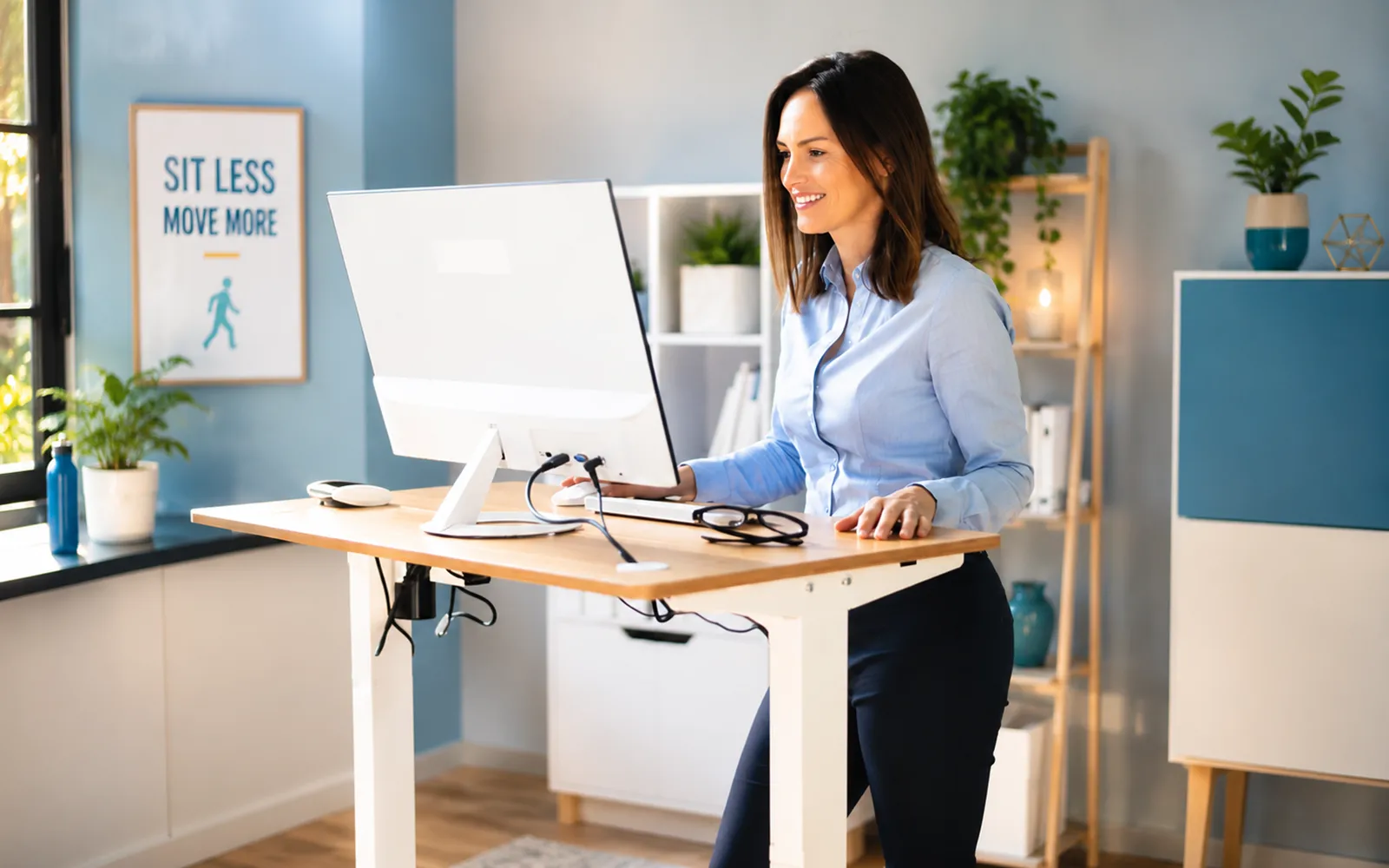
Standing Desks Can Help—but They Are Not the Whole Answer
Standing desks have become a popular response to sedentary office work.
They can be useful because they encourage position changes and reduce some sitting time. But simply replacing prolonged sitting with prolonged standing is not the ultimate goal.
Movement is different from standing still.
A standing workstation works best as one option within a varied day: sit for a while, stand for a while, walk periodically, and change positions according to comfort and task demands.
The healthiest workstation may not be one that forces a single “correct” posture. It may be one that allows frequent variation.
Television Time Is Another Easy Opportunity
Work is not the only source of sedentary time. Leisure can become highly sedentary as well.
Watching a movie or favorite program can be enjoyable and relaxing. There is no reason to eliminate it. But several hours of evening television can quietly extend a day that was already dominated by sitting.
Commercial breaks, episode transitions, or natural pauses can become movement cues. Stand up, refill water, put something away, walk through the house, perform a small household task, or simply move for a few minutes.
Rather than seeing entertainment and movement as opposites, we can build small amounts of activity around the entertainment we already enjoy.
Commuting Can Add Hours of Sitting
Transportation is another major contributor to sedentary time.
Driving often cannot be avoided, particularly in areas built around automobiles. But recognizing commute time as part of the day’s sedentary total can encourage movement before or after the trip.
After a long drive, a brief walk may feel particularly good because the body moves through positions that have remained relatively static.
When circumstances allow, everyday transportation can also become an opportunity for activity. Walking part of a trip, taking public transportation that requires some walking, or choosing stairs instead of escalators can add movement without requiring a separate workout.
Moving After Meals Can Be a Useful Habit
Meals provide another natural cue for movement.
Research on activity breaks and post-meal metabolism suggests that light or moderate movement after eating can help reduce post-meal glucose and insulin responses compared with remaining seated continuously.
This makes a short post-meal walk an appealing Healthy Living habit. It combines movement with something that already occurs every day, reducing the need to remember another separate health task.
A walk after lunch may also provide a mental break during work. An evening walk can become social time with a spouse, family member, or neighbor.
The physiological benefit is only one reason the habit can be worthwhile.
Household Activity Is Still Activity
We sometimes discount movement that does not happen in workout clothing.
Vacuuming, gardening, carrying laundry, washing the car, cleaning, organizing, shopping, and performing home projects all require physical movement.
WHO guidance explicitly recognizes that all physical activity counts, whether it occurs through recreation, transportation, work, sport, or everyday household tasks.
This does not mean that household chores provide exactly the same stimulus as structured aerobic or resistance training. They usually do not.
But they contribute to a lifestyle in which the body remains engaged with the physical world instead of spending nearly every waking hour seated.
Everyday Movement May Help the Brain Too
Movement breaks may provide benefits beyond metabolism and circulation.
A 2026 systematic review and meta-analysis of randomized crossover trials examined the cognitive effects of interrupting prolonged sitting. The researchers found small improvements in executive function and memory when sitting was interrupted with standing or physical activity, although benefits were not clearly demonstrated across every cognitive measure.
This is an emerging area of research, so it would be premature to claim that standing up every half hour dramatically improves brain performance.
Still, the findings fit an experience many people recognize: after sitting and concentrating for a long time, getting up and moving can provide a mental reset.
Sometimes the best response to fading concentration is not another cup of coffee or another twenty minutes staring at the same screen.
It may simply be time to move.
Movement Supports Mood and Sleep as Part of the Bigger Picture
Regular physical activity has benefits that extend well beyond cardiovascular fitness. Current CDC guidance identifies improved sleep, reduced short-term anxiety, better brain health, and lower long-term risks of depression among the benefits associated with physical activity.
Not every light movement break will produce those outcomes on its own. The larger principle is that increasing total physical activity contributes to a healthier daily pattern.
A lunchtime walk may interrupt sitting and provide daylight. Gardening may combine movement with time outdoors. Walking with someone else adds social connection. Household activity can create movement while accomplishing something useful.
Healthy habits often become more sustainable when one behavior serves several purposes at the same time.
Movement Becomes Especially Important With Age
Remaining physically engaged with everyday life becomes increasingly valuable as we grow older.
Movement provides repeated opportunities to use the muscles, joints, balance systems, and coordination required for independent living. Walking around the home, carrying objects, climbing stairs, gardening, shopping, and performing ordinary tasks all help keep physical capabilities connected to daily life.
Formal strength and balance training become especially important with age and should not be replaced by light movement alone. But everyday movement provides the volume of physical experience that surrounds those workouts.
A body that moves regularly receives a very different message from one that spends most of the day inactive.
You Don’t Have to Be Constantly Moving
The message to sit less can easily become another health rule taken to an unnecessary extreme.
Rest is healthy.
Reading a book is healthy.
Watching a movie can be enjoyable.
Sitting with friends over a long meal can contribute to social well-being.
The objective is not to develop anxiety whenever you sit down. Healthy living involves both activity and recovery.
The concern arises when sitting dominates the day so completely that movement becomes the unusual event.
A better goal is balance: use chairs when you want or need them, but continue giving your body regular opportunities to do what it was designed to do—move.
Build Movement Into Your Environment
Behavior is easier to maintain when the environment supports it.
Rather than depending entirely on motivation, arrange everyday routines so that movement happens naturally.
You might:
- Keep commonly used items in locations that require you to get up.
- Choose stairs when the distance is manageable.
- Walk during appropriate phone conversations.
- Place a water bottle away from your desk.
- Take a short walk after one meal each day.
- Park a little farther from entrances when conditions are safe.
- Use household tasks as movement opportunities.
- Set a gentle reminder during long computer sessions.
- Walk while waiting instead of automatically sitting.
- Build social activities around walking occasionally.
None of these choices is dramatic. That is part of their strength.
Small actions are easier to repeat, and repetition is what turns movement into lifestyle.
Don’t Try to Optimize Every Minute
Health advice can become counterproductive when it makes ordinary life feel like a continuous performance test.
You do not need to count every minute seated, calculate every standing interval, or feel guilty because a busy day required several hours at a desk.
Instead, notice patterns.
Do mornings disappear at the computer without getting up? Do evenings routinely involve four hours on the sofa? Could one meeting become a walking conversation? Could dinner be followed by ten minutes outside? Could you stand while performing a task that does not require sitting?
Healthy living often improves through awareness rather than perfection.
Start With One Part of the Day
Trying to redesign an entire routine overnight is rarely necessary.
Choose one sedentary period and change it.
If mornings involve continuous desk work, add a short midmorning movement break. If afternoons are inactive, walk after lunch. If evenings involve television, get up between programs. If commuting leaves you stiff, walk for several minutes after arriving.
Once one change feels normal, another can be added.
This approach turns the goal from “I need to be more active” into something concrete and manageable.
Formal Exercise Still Matters
Encouraging everyday movement should never be interpreted as minimizing exercise.
Current recommendations still encourage adults to obtain at least 150 minutes of moderate-intensity aerobic activity each week, or an equivalent amount of vigorous activity, along with muscle-strengthening activity on at least two days.
Purposeful exercise creates physiological challenges that light everyday movement may not provide. Strength training develops muscular capacity. Brisk walking, cycling, swimming, running, or similar activities challenge the cardiovascular system. Balance and mobility training develop other important physical abilities.
Everyday movement fills the spaces between those activities.
Think of structured exercise as one layer of healthy living and regular daily movement as another.
The strongest lifestyle contains both.
Measure Success by a More Active Day
Wearable devices make it possible to track steps, standing hours, exercise minutes, calories, distance, and dozens of other metrics.
These numbers can be useful when they motivate positive behavior, but they are not required.
You can also measure progress with simpler questions:
- Did I spend less time sitting continuously today?
- Did I walk when I had the opportunity?
- Did I get outside?
- Did I move between long periods of work?
- Did I choose the stairs?
- Did I perform some household activity instead of remaining seated?
- Did my body feel more engaged with the day?
These questions shift attention away from chasing perfect numbers and toward creating a healthier pattern.
The Goal Is Not More Exercise—It Is More Life in Motion
One of the most important changes in modern health thinking is the recognition that physical activity does not belong exclusively inside gyms, workout programs, or scheduled exercise sessions.
It belongs in ordinary life.
Walking to another room counts as movement. Gardening is movement. Carrying groceries is movement. Taking stairs is movement. Playing with children is movement. Cleaning the house is movement. Walking after dinner is movement.
Some of these activities are light. Others can become surprisingly demanding. Together, they create a physical life that looks very different from one spent almost entirely sitting.
Structured exercise remains essential for developing higher levels of cardiovascular fitness, muscular strength, and physical capacity. But the body also benefits from simply being used more often throughout the day.
Sitting Less Is Really About Living More Actively
The phrase “sit less” can sound restrictive, as though healthy living requires giving something up.
A better way to think about it is creating more opportunities to participate physically in the day.
Walk while you talk. Stand while you wait. Take the stairs when you can. Step outside after lunch. Carry something. Work in the garden. Move between periods of concentration. Take a short evening walk instead of moving directly from the dinner table to the sofa.
None of these choices alone will determine long-term health. Together, however, they create a lifestyle in which movement becomes normal rather than exceptional.
We do not need to eliminate sitting, and we do not need to transform every spare minute into exercise. We simply need to remember that the human body benefits from being asked to move regularly.
The goal is not to spend your life avoiding the chair. It is to make sure the chair does not become where most of your life is spent.
Disclaimer
This article is intended for general educational purposes and is not a substitute for individualized medical or exercise advice. Physical activity needs and limitations vary according to health status, mobility, medications, and other individual factors. People with cardiovascular disease, significant mobility or balance limitations, persistent pain, or other medical conditions should consult an appropriate healthcare professional regarding suitable activity levels and exercise recommendations.