Wednesday, 30 September 2026

Research Evidence Pyramid

Understanding the Research Evidence Pyramid

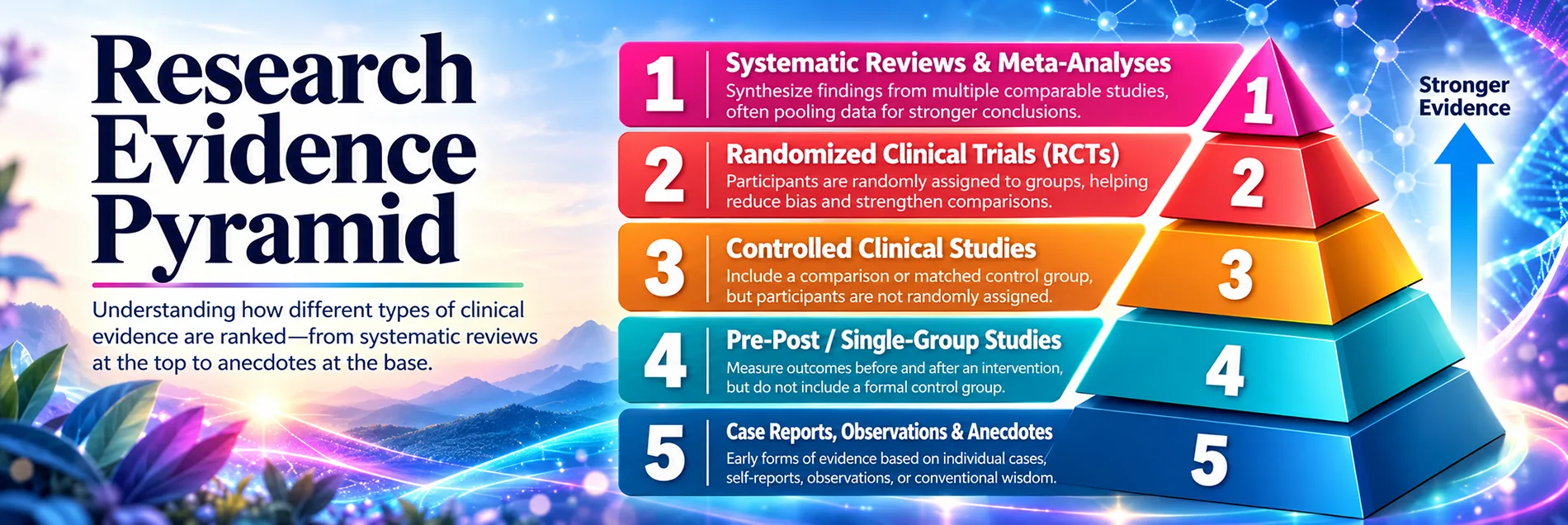
Research evidence can vary considerably in strength and reliability. The Research Evidence Pyramid provides a simple way to understand how different types of studies are generally evaluated. At the top are systematic reviews and meta-analyses that synthesize findings from multiple high-quality studies. Moving downward are randomized clinical trials, controlled studies, observational designs, and finally individual case reports, personal observations, anecdotes, and conventional wisdom.

The pyramid does not mean that lower levels of evidence have no value. Observations and individual experiences often generate important questions that lead to further research. Rather, the hierarchy reflects how much confidence we can generally place in a finding when trying to determine whether an intervention actually produced a particular outcome.

  1. Level 1 — Systematic Reviews and Meta-Analyses
    These represent some of the strongest forms of research evidence when they are based on well-designed, comparable studies. A systematic review carefully identifies, evaluates, and summarizes the available research addressing a particular question. A meta-analysis goes a step further by statistically combining results from multiple studies when appropriate. By examining a larger body of evidence rather than relying on a single experiment, researchers can often reach more reliable conclusions and better understand how consistently an effect has been observed.

  2. Level 2 — Randomized Clinical Trials (RCTs)
    Randomized clinical trials are among the strongest individual study designs for evaluating whether an intervention causes a particular outcome. Participants are randomly assigned to two or more groups, such as an intervention group and a comparison or control group. Randomization helps distribute known and unknown differences between groups more evenly, reducing the likelihood that bias or unrelated factors will explain the results. When appropriate, blinding and placebo controls can provide additional protection against bias.

  3. Level 3 — Controlled Clinical Studies
    Controlled studies include a comparison group but do not randomly assign participants to the different groups. Researchers may compare people receiving an intervention with a similar group that does not receive it or receives a different intervention. These studies can provide valuable information, but without randomization there is a greater possibility that differences between the groups—not the intervention itself—may influence the outcome.

  4. Level 4 — Pre-Post and Single-Group Studies
    These studies follow the same participants before and after an intervention, program, or service. Researchers measure a baseline and then determine whether outcomes change following the intervention. This approach can identify meaningful changes over time, but because there is no separate control group, it can be difficult to determine whether the intervention itself caused the improvement or whether other factors contributed.

  5. Level 5 — Case Reports, Observations, Self-Reports, and Anecdotes
    At the foundation of the pyramid are individual experiences, case reports, surveys, personal observations, self-reported outcomes, and anecdotal evidence. These forms of information can be valuable for identifying patterns, generating hypotheses, and drawing attention to phenomena that deserve further study. Many scientific questions begin with observation. However, because these reports usually lack controls, randomization, and other safeguards against bias, they cannot by themselves establish that one factor caused another.

The key idea is not that one study automatically proves or disproves something. Strong conclusions generally emerge when well-designed research is replicated, different types of evidence point in the same direction, and the findings remain consistent as the scientific literature grows.

Our mission is to empower individuals to reach their fullest potential through education, mindfulness, healthy living, and personal growth. We believe lasting transformation begins by nurturing the mind, strengthening the body, and cultivating habits that support a healthier & purposeful life.

Subscribe to Get Our Latest Articles:

MindBodyWorks  ©2026  All Rights Reserved.