















Carbohydrates are often discussed as though they all follow roughly the same path through the body.
We eat them. Digestion breaks them down. Glucose enters the bloodstream. The body uses or stores the resulting energy.
Fiber changes that story.
Unlike most digestible carbohydrates, dietary fiber contains carbohydrate structures that human digestive enzymes cannot completely break apart in the small intestine. Some forms pass largely intact through the digestive tract. Others are altered physically by water or fermented by microorganisms living in the colon.
That difference gives fiber a remarkable range of functions.
Some fibers help retain water in stool.
Some form viscous gels that change how nutrients move through the digestive tract.
Some influence cholesterol metabolism.
Some alter the speed and magnitude of the glucose response to a meal.
Some provide substrates for intestinal microorganisms, which transform them into compounds the body can then use.
And some fibers do several of these things at once.
Fiber is therefore not simply the part of food that “doesn’t get digested.”
It is a diverse family of carbohydrates whose resistance to ordinary digestion allows them to interact with the body in ways that other carbohydrates generally cannot.
Fiber Takes a Different Route Through Digestion
Most dietary starches and sugars can be broken into smaller molecules that are absorbed in the small intestine.
Fiber resists that process to varying degrees.
The FDA defines dietary fiber for food-labeling purposes as nondigestible soluble and insoluble carbohydrates with at least three sugar units, along with lignin, that are naturally intact in plants, plus certain isolated or synthetic nondigestible carbohydrates shown to produce beneficial physiological effects.
That regulatory definition already hints at an important idea.
Fiber is not one molecule.
Cellulose, beta-glucans, pectins, psyllium, inulin, resistant starches, and many other compounds can behave quite differently once they enter the digestive tract.
Some swell.
Some dissolve.
Some become thick and gel-like.
Some are rapidly fermented.
Some are fermented slowly.
Some resist fermentation almost entirely.
Those properties help determine what a particular fiber actually does.
“Soluble” and “Insoluble” Tell Only Part of the Story
Nutrition traditionally divides fiber into two broad groups.
Soluble fiber dissolves or disperses in water.
Insoluble fiber generally does not.
That distinction is still useful, but modern fiber science shows why it can be too simplistic.
Two soluble fibers can have completely different effects if one creates a thick, viscous gel and another does not. Two insoluble fibers may affect stool differently depending on particle size and water-holding properties.
A major review of fiber physiology concluded that characteristics such as viscosity, fermentability, particle size, and water-holding capacity often predict physiological effects better than the simple soluble-versus-insoluble distinction.
For example, psyllium and oat beta-glucan are soluble fibers that can become viscous.
Inulin is also soluble, but it is highly fermentable and does not create the same type of viscosity.
Wheat bran is largely insoluble and may contribute to stool bulk, particularly when its particles remain relatively coarse.
The category name tells us something.
The physical behavior tells us more.
Viscous Fiber Can Change What Happens After a Meal
Some soluble fibers absorb water and form a gel-like environment within the digestive tract.
That increased viscosity changes the physical conditions through which nutrients move.
Digestive enzymes still work.
Carbohydrates are still absorbed.
But the interaction among food, digestive enzymes, and the intestinal surface can occur differently.
This is one mechanism through which certain viscous fibers can moderate post-meal glucose responses.
The effect should not be interpreted as fiber somehow “canceling carbohydrates.” Rather, the physical properties of the meal can change the rate at which digestible nutrients become available for absorption.
Clinical evidence supports this distinction. In randomized trials involving people with type 2 diabetes, viscous soluble fiber supplementation has improved measures including fasting glucose and HbA1c, although the magnitude varies according to fiber type, dose, study population, and background diet.
This is also why simply reading “5 grams of fiber” on a package does not tell us everything about what that fiber will do.
The grams matter.
The type matters too.
“Fiber is different not because the body ignores it, but because it takes another route—changing digestion, interacting with the gut, and influencing health precisely because it is not handled like ordinary carbohydrate.”
Certain Fibers Can Help Lower LDL Cholesterol
One of the best-established specific effects of viscous soluble fiber involves cholesterol.
Fibers such as beta-glucan and psyllium can interfere with normal intestinal handling and reabsorption of bile acids. Because bile acids are produced from cholesterol, increased loss through the digestive tract can contribute to changes in hepatic cholesterol metabolism and lower circulating LDL cholesterol.
A large 2023 systematic review and dose-response meta-analysis included 181 randomized controlled trials with more than 14,000 participants. Soluble-fiber supplementation reduced LDL cholesterol overall, and each additional 5 grams per day was associated with a further average reduction in LDL cholesterol of roughly 5.6 mg/dL.
Not all fibers produced the same effect.
Another meta-analysis comparing viscous fibers with nonviscous cereal fibers found greater LDL lowering from the viscous forms.
That difference reinforces an important nutritional lesson:
Fiber’s benefits do not arise merely because something has been classified as fiber.
Its physical and biological properties matter.
Fiber Can Change the Contents of the Colon
The colon is where fiber becomes especially interesting.
Humans may lack the enzymes needed to digest many fiber structures, but intestinal microorganisms possess a much broader collection of carbohydrate-processing enzymes.
Certain fibers therefore become food for members of the gut microbial community.
During fermentation, microorganisms can produce metabolites including the short-chain fatty acids acetate, propionate, and butyrate.
These compounds do not simply remain in stool. Much of what is produced is absorbed and can participate in local intestinal physiology and broader metabolism.
But the popular statement that “fiber feeds your good bacteria” is too broad.
Different microorganisms specialize in different substrates.
Different fibers support different microbial activities.
And individuals can respond differently to the same fiber because their microbial communities are not identical.
A systematic review of human intervention studies found that dietary fibers can alter microbial composition and short-chain-fatty-acid production, but responses differed substantially according to the fiber being consumed and the person consuming it.
The microbiome responds to fiber.
It does not respond to every fiber in the same way.
Not Every Fiber Is a Prebiotic
Fiber and prebiotic are also frequently used as though they mean the same thing.
They do not.
The widely used scientific definition developed by the International Scientific Association for Probiotics and Prebiotics describes a prebiotic as a substrate that is selectively used by host microorganisms and produces a health benefit.
Some dietary fibers satisfy that definition.
Others do not.
Inulin and certain fructans, for example, have well-established prebiotic properties.
Other fibers may be fermented broadly without meeting all of the scientific criteria required to call them prebiotics.
And some fibers provide important benefits through viscosity, water retention, or stool bulking without relying primarily on microbial fermentation.
This distinction matters because microbiome marketing has made prebiotic sound like a synonym for healthy fiber.
It is better understood as a specific functional designation.
Fiber Can Support Bowel Regularity—but Again, the Type Matters
Fiber is perhaps most familiar for its effect on bowel movements.
The basic idea is correct.
The details are more complicated.
Certain fibers retain water and increase stool softness or bulk. Coarse insoluble fibers can contribute physical bulk. Gel-forming fibers such as psyllium can retain water as intestinal contents move through the colon.
Other highly fermentable fibers may be largely metabolized by intestinal bacteria and therefore contribute much less intact material to stool.
This helps explain why one fiber supplement may relieve constipation while another mainly produces gas.
A 2022 meta-analysis of 16 randomized controlled trials involving adults with chronic constipation found that fiber supplementation improved overall treatment response, stool frequency, and stool consistency. Psyllium was among the fibers with the clearest evidence, although study results varied and increased flatulence was also reported.
So even the familiar advice to “eat more fiber for constipation” deserves some nuance.
The right fiber can help.
Simply adding any fiber in any amount does not guarantee the same effect.
Increasing Fiber Too Quickly Can Be Uncomfortable
Someone eating very little fiber may decide to correct the situation overnight.
Breakfast suddenly contains bran cereal and chia seeds.
Lunch adds a large bowl of beans.
Dinner brings lentils, broccoli, whole grains, and a fiber supplement.
The nutritional intention may be excellent.
The digestive system may disagree with the speed of implementation.
Fermentation produces gases, and rapidly increasing fermentable carbohydrate can lead to bloating, pressure, or changes in bowel habits. NIDDK therefore recommends increasing fiber gradually so the digestive system has time to adjust and consuming adequate fluids as intake rises.
This is not evidence that fiber is harmful.
It is a reminder that adaptation matters in nutrition too.
Fiber Is One Reason Carbohydrate Quality Matters
Fiber also exposes a weakness in the way carbohydrates are sometimes discussed.
A lentil and a soft drink both contain carbohydrate.
So do oatmeal, an apple, white bread, beans, berries, brown rice, candy, and barley.
Grouping all of them simply as “carbs” ignores enormous differences in physical structure, fiber, micronutrients, food matrix, digestion, and metabolic effects.
One of the largest syntheses of carbohydrate-quality evidence combined prospective studies and randomized trials and found that higher dietary-fiber and whole-grain intake was consistently associated with lower rates of several major chronic diseases and mortality. Clinical trials also supported favorable effects on several cardiometabolic risk markers.
Not all of those benefits can be attributed to fiber alone.
Fiber-rich foods also contain vitamins, minerals, phytochemicals, and other components, and people who consume more high-fiber foods may differ in other behaviors.
But the evidence strongly supports fiber as one of the important characteristics distinguishing higher-quality carbohydrate sources.
The question is therefore not simply:
How many carbohydrates am I eating?
It is also:
What kind of carbohydrate-containing foods are providing them?
A Bean Is More Than Its Fiber
This distinction becomes especially important when fiber moves from food into supplements and fortified products.
Beans contain fiber.
But they also provide protein, potassium, folate, minerals, resistant starch, and a complex food matrix.
Oats provide fiber along with starch, protein, micronutrients, and other compounds.
Berries bring fiber together with vitamins and phytochemicals.
Nuts and seeds provide fiber alongside unsaturated fats, protein, and minerals.
Vegetables provide different mixtures again.
An isolated fiber added to a beverage may produce a legitimate physiological benefit. The FDA specifically allows certain isolated or synthetic nondigestible carbohydrates to be labeled as dietary fiber when evidence demonstrates beneficial physiological effects.
That means added fiber should not automatically be dismissed as “fake fiber.”
But neither should a fiber-fortified food automatically be considered nutritionally equivalent to a naturally fiber-rich food.
One nutrient cannot reproduce the entire food.
Fiber Supplements Can Still Be Useful
There are situations in which concentrated fiber is practical.
Psyllium has considerable evidence for both bowel function and LDL-cholesterol reduction.
Specific fibers may be recommended for particular gastrointestinal needs.
Someone who consistently falls short of adequate fiber through food may find supplementation convenient.
And isolated fibers allow researchers and clinicians to target a physiological effect much more precisely than simply advising someone to eat “more plants.”
So the useful comparison is not:
whole food good, supplement bad.
It is:
What is the purpose?
If the objective is improving the overall quality and variety of the diet, whole fiber-rich foods bring advantages far beyond isolated fiber.
If the objective is achieving a particular therapeutic fiber effect, a well-studied supplement may be appropriate.
Nutrition becomes clearer when we stop expecting every food or supplement to perform the same job.
How Much Fiber Do We Actually Need?
The current U.S. Dietary Reference Intakes use an Adequate Intake, or AI, for fiber rather than an RDA.
The underlying benchmark is approximately 14 grams of total fiber per 1,000 calories consumed.
For adults ages 19–50, that translates to an AI of 38 grams per day for men and 25 grams for women. After age 50, the values are 30 grams for men and 21 grams for women, largely reflecting lower estimated energy intake rather than a conclusion that fiber suddenly becomes biologically unimportant with age.
These values are reference targets for generally healthy populations, not rigid thresholds that separate a healthy diet from an unhealthy one.
The fiber DRIs are also part of the macronutrient reference values currently undergoing U.S.-Canadian review, reflecting the substantial amount of new evidence accumulated since the original recommendations were developed.
For practical purposes, the more useful question may be whether fiber-rich foods regularly appear throughout the diet.
What Does a Fiber-Rich Diet Actually Look Like?
There is no requirement to build meals around bran or consume an enormous salad every day.
Fiber accumulates from many foods.
A practical pattern might include:
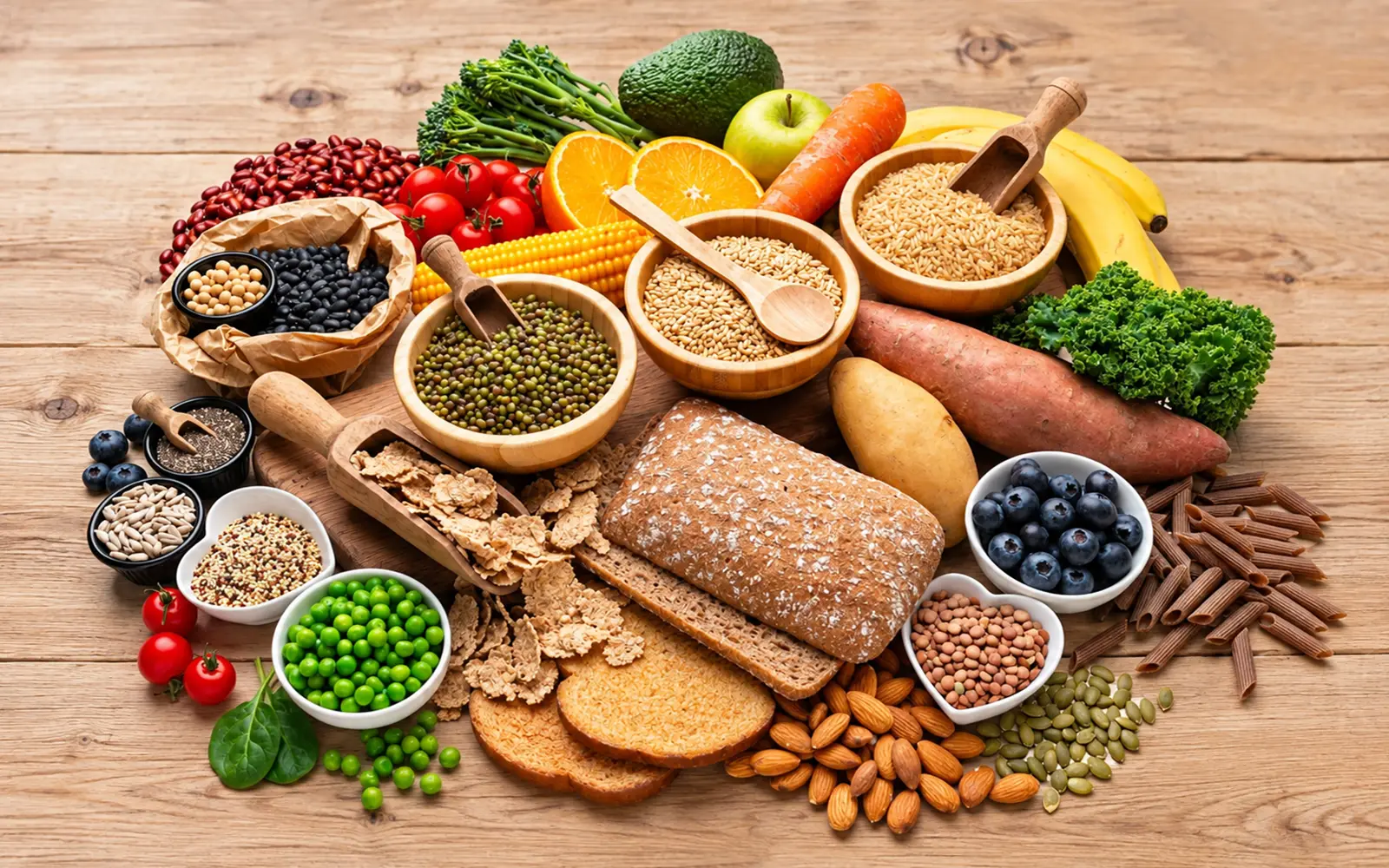
- Legumes regularly: beans, lentils, chickpeas, and peas can contribute substantial fiber along with protein and minerals.
- Whole grains in place of some refined grains: oats, barley, whole wheat, bulgur, brown rice, and other intact or less-refined grains add different fiber structures.
- Whole fruits: berries, pears, apples, oranges, and many other fruits contribute fiber along with water and micronutrients.
- Vegetables across the day: variety matters because different plants provide different fiber structures and associated nutrients.
- Nuts and seeds: almonds, pistachios, chia, flax, and other varieties can contribute fiber within nutrient-dense foods.
- Gradual variety rather than one enormous fiber dose: spreading different sources through ordinary meals can be easier to tolerate and creates a more diverse nutritional pattern.
The point is not to consume every item on that list daily.
It is to recognize that fiber becomes easier to obtain when it comes from many ordinary foods rather than one heroic serving.
Diversity May Matter Alongside Quantity
Two diets can contain the same total grams of fiber while providing very different substrates to the digestive tract.
One might obtain most of its fiber from a single fortified product.
Another might obtain the same amount from oats, beans, berries, vegetables, nuts, seeds, and whole grains.
Those diets are not biologically identical.
Different plant foods contain different mixtures of cellulose, hemicelluloses, pectins, beta-glucans, resistant starches, fructans, and other nondigestible carbohydrates.
This diversity provides a wider variety of substrates to the gastrointestinal environment and microbial community.
Microbiome science is still developing, and we should resist simplistic claims that eating a certain number of plants will guarantee an ideal microbiome. There is no universally agreed single composition of a “perfect” gut microbiome.
A 2026 international consensus statement on gut health specifically emphasized that gut health cannot be reduced to one microbiome measurement and proposed a broader definition incorporating normal gastrointestinal function and the absence of gut-related symptoms that impair quality of life.
That is a useful correction to current wellness culture.
Fiber diversity is nutritionally sensible.
It does not need exaggerated microbiome promises to justify it.
Fiber Can Affect Fullness—but It Is Not a Guaranteed Appetite Switch
Fiber-rich foods are also frequently promoted for satiety.
There are good reasons for that.
Some high-fiber foods require more chewing.
Some hold water and increase food volume.
Viscous fibers can alter gastric and intestinal processes.
Fiber-rich whole foods frequently have lower energy density than highly refined foods.
Fermentation products may also participate in gut-brain and metabolic signaling.
But different fibers produce different effects on appetite, and not every additional gram of fiber makes someone noticeably fuller.
The entire meal matters.
Protein, fat, water content, energy density, texture, palatability, eating rate, and the individual all influence satiety.
This is another reason to avoid turning fiber into a magic nutrient.
Its benefits are real enough without promising effects it does not reliably produce for everyone.
Fiber Is Not Always Something to Maximize
Nutrition advice sometimes moves from more is generally beneficial to the most possible must be best.
Those ideas are not equivalent.
Extremely high fiber intake can create gastrointestinal discomfort and may be difficult to tolerate for some people.
People with certain bowel strictures, obstruction risk, severe motility problems, active gastrointestinal disease, or particular medical conditions may receive individualized recommendations that differ substantially from population guidance.
People with irritable bowel syndrome may also tolerate certain fermentable fibers better than others. NIDDK notes, for example, that soluble fiber may be more helpful than insoluble fiber for some people with IBS, and dietary changes sometimes need to be individualized.
Fiber is beneficial precisely because of what it does within the gastrointestinal tract.
When gastrointestinal physiology changes, the appropriate fiber strategy can change as well.
The Nutrition Facts Label Gives a Number, Not the Whole Story
Looking at dietary fiber on a Nutrition Facts label is useful.
It tells you how many grams have been counted as fiber under FDA rules.
What it usually does not tell you is whether those grams are primarily viscous, fermentable, bulking, prebiotic, intrinsic to the original food, or added during manufacturing.
The ingredient list can sometimes provide clues.
But even then, interpreting the exact physiological effect from the package alone may be difficult.
This is not a flaw in labeling.
A nutrition label has to compress complex food chemistry into usable information.
We simply need to understand what the number means.
Total fiber tells us quantity. It does not completely describe function.
The Carbohydrate That Connects Food, Digestion, and the Microbiome
Fiber occupies an unusual place in nutrition.
It is classified as carbohydrate, yet much of it escapes the digestive process that defines our usual understanding of carbohydrates.
Because it is not completely absorbed in the small intestine, it can change the physical environment through which other nutrients move.
Because some forms retain water, they can alter stool.
Because certain fibers become viscous, they can influence glucose and cholesterol metabolism.
Because others reach the colon and are fermented, they create a direct nutritional connection between what we eat and the microbial ecosystem living within us.
And because fiber usually arrives within fruits, vegetables, legumes, whole grains, nuts, and seeds, increasing it often changes much more about the diet than fiber alone.
That may be fiber’s most important lesson.
Nutrition is not only about how much of a macronutrient we consume.
It is also about how the body encounters it.
“Fiber is different not because the body ignores it, but because it takes another route—changing digestion, interacting with the gut, and influencing health precisely because it is not handled like ordinary carbohydrate.”
Fiber does not need to be turned into another nutritional obsession.
It simply deserves to be understood for what it is:
a diverse group of carbohydrates that the body handles differently—and often benefits from because of that difference.
Nutrition and Health Disclaimer
This article is intended for general educational purposes and is not individualized nutrition or medical advice. Fiber needs and tolerance vary with age, energy intake, gastrointestinal function, medications, and health status. People with significant gastrointestinal disease, bowel narrowing or obstruction risk, recent gastrointestinal surgery, swallowing difficulties, chronic constipation that does not improve, unexplained changes in bowel habits, or other medical conditions affecting digestion should seek appropriate professional guidance before substantially increasing fiber or using concentrated fiber supplements.