







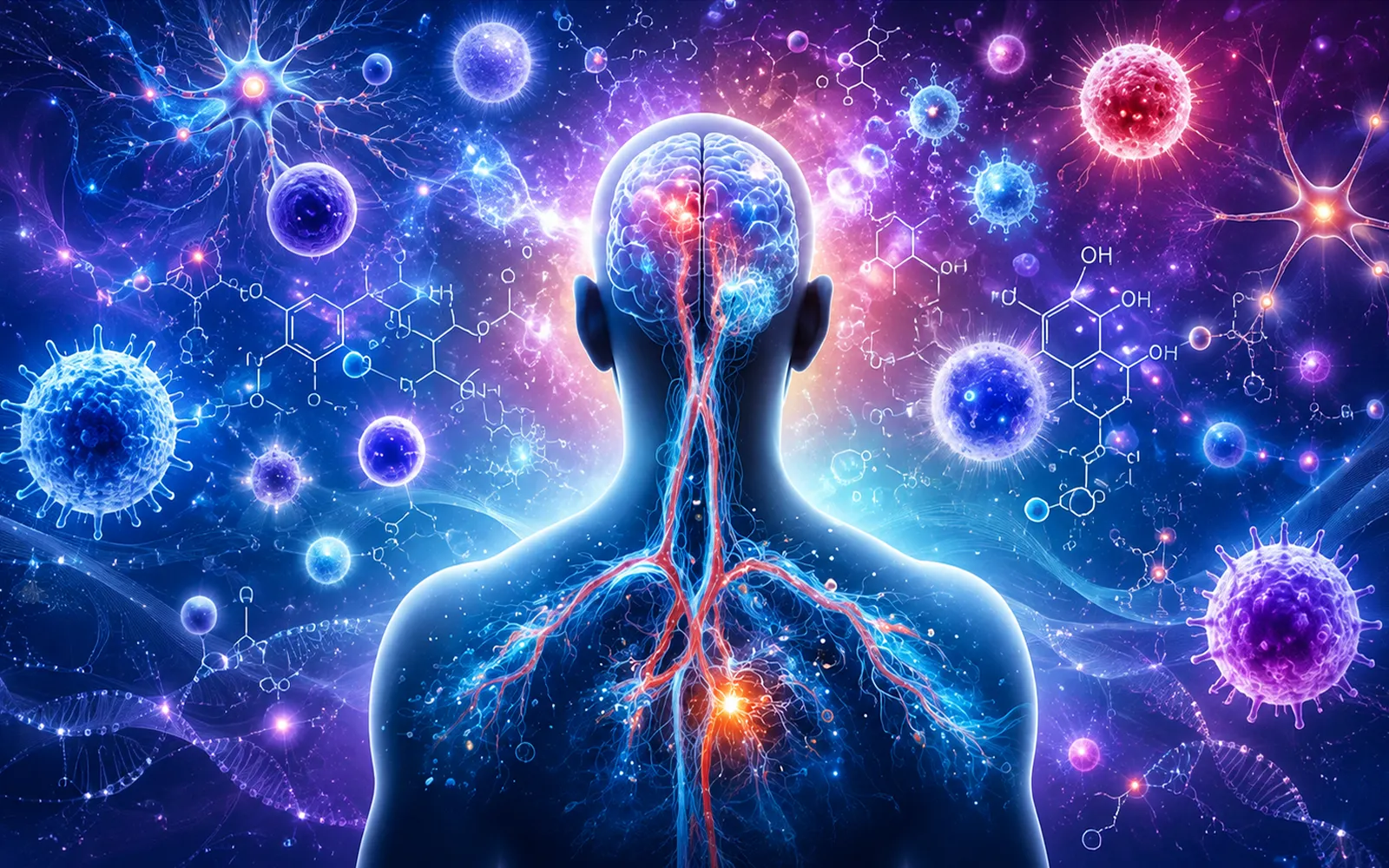





Most of the body’s regulation happens quietly.
Your heart changes its rhythm from moment to moment.
Breathing speeds up or slows down.
Muscles tighten before you consciously notice the tension.
Sweat-gland activity changes with arousal.
Blood vessels constrict and relax.
The nervous system continually adjusts these processes in response to movement, thoughts, emotions, temperature, pain, and the demands of everyday life.
Usually, we experience only the end result.
We feel tense. Our shoulders ache. A headache begins. Our breathing feels shallow. Our heart seems to be racing.
Biofeedback offers a different approach.
Instead of asking us simply to try to relax, a biofeedback machine measures a physiological signal and shows us—in real time—what the body is actually doing. We can then change our breathing, release a muscle, adjust our posture, focus our attention, or practice another self-regulation technique and immediately see whether the physiology changes with us.
That feedback turns something normally invisible into something we can learn from.
And that is where the practical value of biofeedback lies.
Biofeedback is not a machine that relaxes the body for us. It is technology that can help teach us how our own actions influence the body—so that physiological regulation becomes a skill rather than a guess.
What a Biofeedback Machine Actually Does
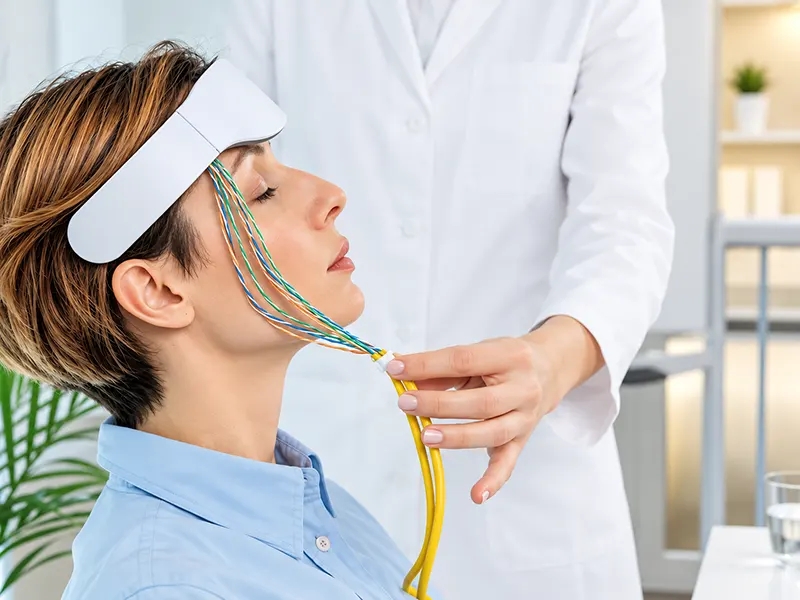
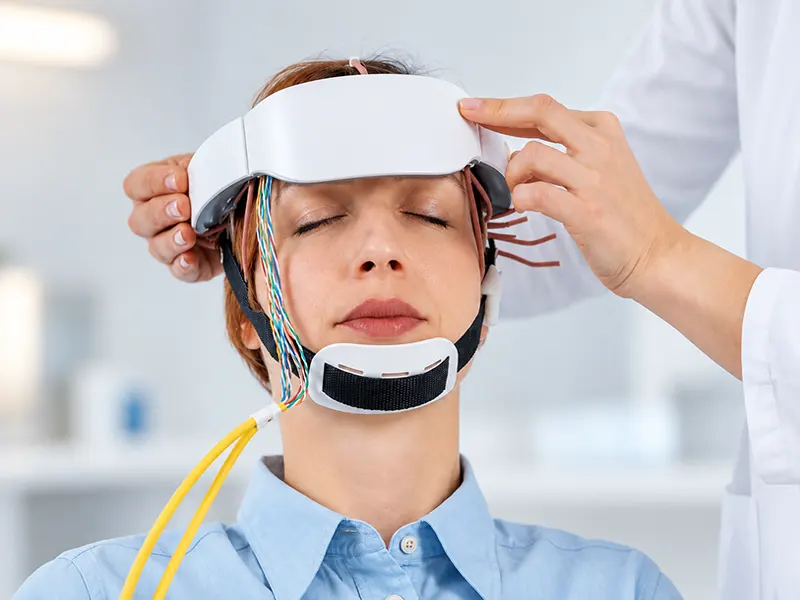
At its core, biofeedback is a noninvasive, drug-free training technique that teaches people to influence bodily processes normally considered involuntary, such as muscle tension, blood pressure, and heart rate. A practitioner attaches sensors to the body — nothing invasive, usually just electrodes or clips — and those sensors translate an internal signal into an external one: a rising or falling tone, a moving line on a screen, a color that shifts from red to green.
The process typically unfolds like this:
- Baseline measurement — noninvasive equipment records a chosen physiological parameter, establishing where the body starts
- Signal conversion — that measurement becomes a feedback signal the person can look at, hear, or feel
- Active practice — the person uses the signal to consciously practice influencing the function, often paired with breathing exercises, relaxation techniques, or mental imagery
- Skill transfer — with enough practice, many people learn to recognize and influence these body functions on their own, without needing the equipment
Individual sessions usually run 30 to 45 minutes, and most programs pair clinic visits with home practice to reinforce the skill between appointments.
Why Seeing the Signal Can Change the Learning Process
Consider muscle tension.
Someone with chronically elevated shoulder tension may genuinely believe the muscles are relaxed because that level of activation has become familiar.
An electromyographic biofeedback sensor can reveal otherwise.
The person lowers the shoulders.
The signal changes slightly.
They unclench the jaw.
It changes again.
They exhale slowly and deliberately release the muscle.
Now the graph falls markedly.
What was previously subjective becomes observable.
The person begins learning:
This is what unnecessary tension feels like.
This is what releasing it feels like.
This is what actually changes the muscle signal.
The same principle can apply to cardiovascular regulation.
A person may be told to “breathe slowly,” but without feedback they cannot see how different breathing patterns affect heart rhythm.
With heart-rate-variability biofeedback, the relationship becomes visible.
That immediate connection between action and physiological consequence is what distinguishes biofeedback from passive health tracking.
“The real value of biofeedback is not the machine’s ability to read the body. It is the opportunity to use that information to teach the body a response we can eventually recognize and practice for ourselves.”
Biofeedback Is Training, Not Just Monitoring
A smartwatch may tell you your heart rate rose during a stressful meeting.
That is useful monitoring.
Biofeedback goes further.
It gives you information while you are attempting to influence the response.
You slow your breathing.
The cardiovascular pattern changes.
You tense a muscle deliberately and then release it.
The EMG signal rises and falls.
You practice warming your hands.
The temperature feedback changes.
This creates a closed learning loop:
measure → observe → adjust → measure again.
Repeated often enough, the process can improve awareness of bodily responses and help some people gain better voluntary influence over processes that initially seemed automatic.
That makes biofeedback unusually practical among wellness technologies.
It does not merely tell you something about yourself.
It gives you a way to practice changing something.
Heart Rate Variability Biofeedback: Training Cardiovascular Regulation
One of the most widely studied forms is heart rate variability biofeedback, or HRV biofeedback.
Heart rate variability refers to the changing time intervals between heartbeats.
A healthy heart does not beat at perfectly equal intervals like a metronome. The spacing changes continuously under the influence of breathing, autonomic regulation, activity, posture, emotions, sleep, illness, and other factors.
During HRV biofeedback, a sensor measures beat-to-beat timing while the person usually practices slow, controlled breathing.
The display shows the resulting pattern.
This lets the person experiment until breathing and cardiovascular rhythms begin to coordinate more strongly.
The resulting waves can become remarkably visible on the screen.
Why Slow Breathing Changes the Heart Rhythm
Breathing and heart rate naturally interact.
During inhalation, heart rate commonly rises somewhat.
During exhalation, it generally slows.
This phenomenon is called respiratory sinus arrhythmia.
At relatively slow breathing rates—often near an individual’s cardiovascular resonance range—the interaction among breathing, blood-pressure regulation, and heart-rate changes can produce particularly large rhythmic oscillations.
The baroreflex, which helps regulate short-term blood pressure, is an important part of this process.
HRV biofeedback therefore provides more than a generic relaxation exercise.
It allows someone to practice a breathing pattern while directly observing how that pattern affects cardiovascular regulation.
That is a genuine physiological training effect.
HRV Biofeedback Can Increase the Variability Being Trained
Recent research gives us a clear positive finding.
A 2025 systematic review and meta-analysis of remote HRV-biofeedback programs included 18 studies and 1,352 participants. The pooled results showed a meaningful increase in HRV compared with control conditions.
That matters because the intervention successfully changed the physiological signal it was designed to train.
The same review found improvement in depressive symptoms, although pooled stress and anxiety effects were less consistent.
For practical purposes, we can draw a useful distinction:
HRV biofeedback has good evidence that people can learn to alter cardiovascular patterns through feedback-assisted breathing, while the downstream emotional benefits vary more from person to person and study to study.
That is still an important result.
Physiological self-regulation does not need to solve every psychological problem in order to be useful.
Blood Pressure May Benefit as Well
Biofeedback has also been studied in people with hypertension.
A 2024 systematic review and meta-analysis of 20 studies found average reductions in both systolic and diastolic blood pressure among participants receiving biofeedback. The authors estimated average reductions of approximately 4.5 mmHg systolic and 5.2 mmHg diastolic. However, the studies were heterogeneous and much of the evidence was older or methodologically limited.
A more recent meta-analysis focused specifically on HRV biofeedback in people with cardiovascular disease found smaller but still significant reductions—about 3 mmHg in both systolic and diastolic pressure—along with improvements in several HRV measures.
Those are not replacements for antihypertensive treatment.
But they are physiologically meaningful enough to make biofeedback interesting as an adjunctive self-regulation tool for appropriate people.
It gives us a concrete example of technology being used not merely to observe cardiovascular physiology, but to help train it.
EMG Biofeedback: Making Muscle Tension Visible
Electromyographic biofeedback takes a different physiological target.
Surface electrodes detect electrical activity produced when muscles contract.
The feedback might appear as a rising bar, graph, numerical value, or sound.
This can be used in two opposite ways.
Someone with excessive muscle tension can practice reducing activation.
Someone recovering from weakness or impaired motor control can practice increasing or improving activation.
That flexibility is one reason EMG biofeedback has found applications in headache management, physical therapy, rehabilitation, and motor retraining.
Learning to Relax a Muscle Is More Specific Than “Relaxing”
The phrase relax your shoulders sounds simple.
But if someone does not recognize how much tension they are holding, the instruction provides little guidance.
EMG feedback can show whether a relaxation strategy is actually changing muscle activity.
This can be particularly relevant for people whose tension becomes habitual.
Instead of asking: Do I feel relaxed?
The person can ask: Did the muscle activity decrease when I did that?
Eventually, the goal is to associate the falling signal with an internal sensation that can be recognized without the machine.
That transition—from external measurement to internal awareness—is one of the most practical physiological benefits of biofeedback.
Headaches Are One Area Where This Matters
Muscle-related biofeedback has a long history in headache treatment.
A 2023 systematic review of EMG biofeedback for primary headaches found that a number of controlled studies reported improvements, with the strongest quantitative evidence suggesting benefit for headache intensity, although effects on frequency and duration were less convincing.
A broader 2025 meta-analysis of biofeedback for migraine found reductions in headache frequency and severity compared with waiting-list controls and reported improvements in migraine-related disability and quality of life. Biofeedback was not clearly superior to active treatments such as medication or cognitive behavioral approaches.
NCCIH similarly describes biofeedback as potentially helpful for some headache conditions while acknowledging that results vary by headache type and study quality.
The practical implication is positive without being exaggerated:
Biofeedback can give some people a drug-free way to recognize and modify physiological patterns—such as muscular tension or autonomic arousal—that can contribute to headache symptoms.
Biofeedback Can Also Be Used to Activate, Not Just Relax
This is one of the most interesting aspects of the technology.
Biofeedback is often described as a relaxation tool.
But sometimes the physiological problem is not excessive activation.
It is insufficient or poorly coordinated activation.
After a stroke, for example, someone may have difficulty recruiting particular muscles effectively.
An EMG biofeedback system can detect even small attempts at activation and show them on a screen.
That provides immediate reinforcement:
Yes—that attempt activated the muscle.
The patient can then repeat the movement.
A 2024 systematic review and meta-analysis of randomized trials found that EMG biofeedback improved limb function after stroke and produced short-term improvements in certain measures of joint range of motion, although long-term evidence was less certain.
A newer 2026 synthesis also found improvements in motor-function measures and active range of motion when EMG-based feedback was added to rehabilitation, while noting substantial heterogeneity among studies.
This illustrates a broader point:
Biofeedback is not fundamentally about calming the body. It is about improving control of a measurable physiological process.
Sometimes that means less muscle activity. Sometimes it means more.
The Same Principle Can Help With Pelvic-Floor Training
Pelvic-floor rehabilitation provides another practical example.
Many people have difficulty knowing whether they are contracting the correct muscles.
A biofeedback sensor can show whether the pelvic-floor muscles are actually activating and can help a patient learn what an effective contraction feels like.
The evidence suggests that pelvic-floor muscle training itself remains the essential treatment, and adding biofeedback does not necessarily produce large additional benefits for everyone. A 2025 Cochrane review found little or no average improvement in several incontinence outcomes from routinely adding biofeedback to pelvic-floor training.
But that does not mean the technology lacks practical value.
A 2026 meta-analysis found that EMG biofeedback added to pelvic-floor training produced small improvements in symptoms and a larger improvement in pelvic-floor muscle strength, with the authors suggesting particular usefulness for people who have difficulty identifying the correct contraction.
That is exactly where biofeedback can be most helpful:
when the problem is not knowing whether you are doing the exercise correctly.
Biofeedback Can Strengthen Interoceptive Awareness
One of the less obvious benefits of biofeedback may be improved awareness of internal bodily states.
Psychologists and neuroscientists often use the term interoception to describe perception of signals originating within the body.
People vary considerably in how clearly they recognize these signals.
Some notice muscle tension early.
Others notice it only when pain develops.
Some recognize the first changes in breathing during stress.
Others become aware only after substantial arousal has accumulated.
Biofeedback can help connect an internal sensation with an external physiological signal.
The screen says the muscle is tightening.
You begin to notice what that feels like.
The heart-rhythm pattern changes.
You begin to recognize what a slower, coordinated breathing pattern feels like.
Over time, the technology can help improve the body’s readability.
That may be one of its most transferable benefits.
The Real Goal Is Earlier Recognition
Imagine that someone normally recognizes stress only when it has become overwhelming.
Shoulders already tight.
Jaw clenched.
Breathing shallow.
Heart racing.
Thoughts moving quickly.
Biofeedback training may help that person recognize earlier stages:
My shoulders are beginning to rise.
My breathing has changed.
I am holding my breath while concentrating.
My physiological arousal is increasing.
Earlier recognition creates more opportunity for response.
This is where the overlap with Mental Wellness becomes especially useful.
Biofeedback does not eliminate life’s stressors.
It can help someone become better at recognizing how the body is responding to them.
Physiological Regulation Is a Skill
This is perhaps the most positive conclusion to draw from the research.
We often think of heart rate, blood pressure, muscle tension, and autonomic activity as processes that simply happen to us.
Most are not under simple direct voluntary control.
You cannot usually command your heart:
Beat more variably.
You cannot tell your blood vessels:
Improve baroreflex regulation.
But you can alter processes that influence them.
- Breathing.
- Muscle activity.
- Posture.
- Attention.
- Movement.
- Relaxation.
Biofeedback reveals the physiological consequence of those actions.
The machine turns indirect control into something observable.
That is why practice matters.
What a Practical Biofeedback Session Might Look Like
Consider HRV biofeedback.
You sit comfortably with a heart-rate sensor attached.
The screen displays the changing intervals between heartbeats.
You begin breathing slowly.
At first, the cardiovascular pattern may look irregular.
You adjust the breathing rate slightly.
The waves become larger and more organized.
You practice keeping the breathing relaxed rather than forceful.
Over several sessions, you begin recognizing the breathing pattern without looking constantly at the screen.
Eventually, you can reproduce much of the technique during ordinary life.
Or consider EMG training.
Electrodes are placed over a muscle that tends to remain tense.
You watch the activity level.
You deliberately contract it.
The signal rises.
You release.
It falls—but perhaps not as far as expected.
You try again.
Gradually, you learn the difference between partial release and genuine relaxation.
The technology has given the nervous system an immediate lesson.
Practice Can Eventually Matter More Than the Machine
Mayo Clinic identifies the long-term objective of biofeedback clearly: people ideally learn to use the skills on their own without the equipment.
That makes biofeedback different from technology that creates permanent dependence.
A sleep tracker is useful only while it is tracking.
A heart-rate monitor is useful only while it is measuring.
Biofeedback can potentially teach something that remains useful after the display is turned off.
The machine may be most valuable at the beginning, when the body’s signals are unfamiliar.
As awareness improves, the external feedback can become less necessary.
The best outcome may not be getting better at watching the machine. It may be getting better at understanding your body without it.
Why Biofeedback Feels So Empowering
Part of what makes biofeedback compelling is psychological, not just physiological. Watching these measurements shift in real time in response to different emotions, thoughts, or behaviors gives people a direct, felt sense that they can influence physical functions they may not have previously realized were within their control. That shift — from “this happens to me” to “I can influence this” — is often described by patients as the most meaningful part of the process.
It also fits naturally alongside other care rather than replacing it. In clinical settings, practitioners often combine biofeedback with treatments like Cognitive Behavioral Therapy or relaxation training, using it as one element of a broader, multi-pronged approach rather than a stand-alone cure.
Practically speaking, biofeedback also carries a favorable safety profile: it’s noninvasive, and there are no meaningful risks, side effects, or complications associated with it. That combination — real physiological engagement with essentially no downside risk — is part of why so many healthcare providers are comfortable recommending it as a first-line or complementary option.
Different Goals Need Different Biofeedback
There is no universal biofeedback machine that is best for everyone.
The right technology depends on what you want to train.
For stress-related cardiovascular regulation, HRV and breathing biofeedback may be especially relevant.
For habitual muscle tension or physical rehabilitation, EMG biofeedback may be more useful.
For learning peripheral warming or vascular responses, thermal biofeedback may be appropriate.
For sympathetic arousal awareness, electrodermal feedback can provide information.
For certain neurological or attentional applications, neurofeedback is available, although evidence varies substantially according to the condition and protocol.
The important question is not:
Which machine has the most impressive dashboard?
It is:
Which physiological process are you trying to learn to regulate?
How to Use Biofeedback Practically
For someone interested in biofeedback for general wellness rather than treatment of a medical disorder, the most useful approach is usually simple:
- Choose one clear physiological target. Trying to optimize heart rate, HRV, breathing, temperature, muscle tension, and brain waves simultaneously creates unnecessary complexity.
- Use feedback to learn, not merely to score yourself. The purpose is to discover which actions reliably change the signal.
- Practice under reasonably consistent conditions. Physiological measurements vary with posture, movement, caffeine, illness, sleep, exercise, and other factors.
- Look for repeatable responses rather than perfect numbers. Can you reliably release a muscle? Can you produce a smoother breathing-heart rhythm relationship? That matters more than competing for a score.
- Transfer the skill away from the device. Practice occasionally without looking at the screen and see whether you can reproduce the sensation or technique.
- Use professional guidance when the goal is clinical. Headache disorders, hypertension, stroke rehabilitation, chronic pain, pelvic-floor dysfunction, significant anxiety, or other medical conditions deserve appropriately trained guidance rather than trial-and-error consumer treatment.
That last distinction keeps biofeedback useful without asking consumer technology to replace healthcare.
What Benefits Are Most Realistic to Expect?
Biofeedback is most useful when expectations match what the technology actually does.
A realistic benefit is learning to reduce excessive muscle activation.
Another is learning a breathing pattern that produces measurable cardiovascular changes.
Another is improving the ability to activate a weak muscle during rehabilitation.
Another is recognizing physiological arousal earlier.
For certain conditions, those skills can translate into meaningful clinical improvements such as reduced headache burden, modest blood-pressure reductions, improved motor rehabilitation, or better symptom self-management.
What biofeedback should not promise is total voluntary control over the autonomic nervous system or guaranteed relief from every stress-related symptom.
That is not necessary for the technology to be valuable.
A modest increase in physiological control can still be useful.
The Physiological Benefit Is in Learning the Response
Biofeedback machines can be impressive.
Graphs move.
Heart rhythms appear on screens.
Muscle activity becomes visible.
Numbers change in real time.
But the screen itself is not the benefit.
The benefit is what the person learns from it.
A person who learns to identify and release muscle tension has gained something useful.
A person who learns to produce a slower, more coordinated breathing pattern has gained something useful.
A rehabilitation patient who finally sees the intended muscle activate has gained something useful.
A person who begins recognizing rising physiological arousal before it becomes overwhelming has gained something useful.
These are not abstract technological achievements.
They are practical physiological skills.
What the Research Says About the Benefits
Biofeedback has moved well beyond folk wellness practice — it has a genuine, growing evidence base, particularly for a handful of well-studied conditions.
Migraine and chronic headache. A 2025 systematic review and meta-analysis found that biofeedback interventions can effectively reduce headache frequency and improve comorbid symptoms such as anxiety and insomnia, though the same review noted meaningful methodological differences and varying evidence quality across the underlying studies — a reminder that, like most behavioral therapies, results vary by protocol and individual.
Stress, anxiety, and mood. A meta-analysis of remote HRV biofeedback programs covering more than 1,300 participants found a medium-sized improvement in both depression symptoms and heart rate variability itself compared with control conditions. A separate 2025 review of recent trials concluded that HRV biofeedback shows real preventive potential for stress, anxiety, and depressive symptoms across a range of populations, while also noting that larger, more rigorously controlled trials are still needed to confirm how durable the effects are over time.
Chronic pain and high blood pressure. Biofeedback is widely used to help manage high blood pressure, tension headaches, migraines, chronic pain, and urinary incontinence — though some conditions, like high blood pressure, may take 20 or more sessions before meaningful improvement appears.
Physical rehabilitation. As part of physical therapy, biofeedback can help retrain the brain to control muscles more effectively after injury, surgery, or neurological conditions — giving patients real-time confirmation that a muscle is (or isn’t yet) firing correctly, long before that control returns to conscious “feel.”
Notably, researchers are candid about the limits of certainty here. The exact mechanisms aren’t fully mapped for every condition, though it’s well established that biofeedback promotes relaxation, which helps relieve a number of stress-related conditions. That kind of honesty is a feature, not a weakness — it reflects a field that’s actively being refined through ongoing clinical research rather than one resting on fixed claims.
“The real value of biofeedback is not the machine’s ability to read the body. It is the opportunity to use that information to teach the body a response we can eventually recognize and practice for ourselves.”
The Bigger Picture
What makes biofeedback quietly remarkable is how it reframes the relationship between mind and body. It doesn’t ask anyone to believe something on faith — it puts a number, a tone, or a moving line directly in front of you and says: this is what your body is doing right now, and here’s what happens when you try to change it. For many people, that visible, immediate proof is the missing piece that makes relaxation techniques, breathing exercises, and stress management finally click — not as abstract advice, but as something they can watch working in real time.
Health and Mental Wellness Disclaimer
This article is intended for general educational purposes and is not individualized medical, psychological, or rehabilitation advice. Biofeedback technologies differ in their sensors, accuracy, protocols, intended uses, and clinical evidence. Consumer biofeedback devices should not be assumed to be equivalent to professional clinical systems. Biofeedback should not replace prescribed treatment for hypertension, cardiovascular disease, migraine, chronic pain, neurological conditions, significant anxiety, pelvic-floor disorders, or other diagnosed conditions. People using biofeedback for a medical or rehabilitation purpose should consider guidance from an appropriately qualified healthcare professional. Mayo Clinic also advises discussing biofeedback with a healthcare professional when medical conditions such as certain heart-rhythm or skin disorders could affect its suitability.