Programs That Help Turn Knowledge Into Meaningful Change
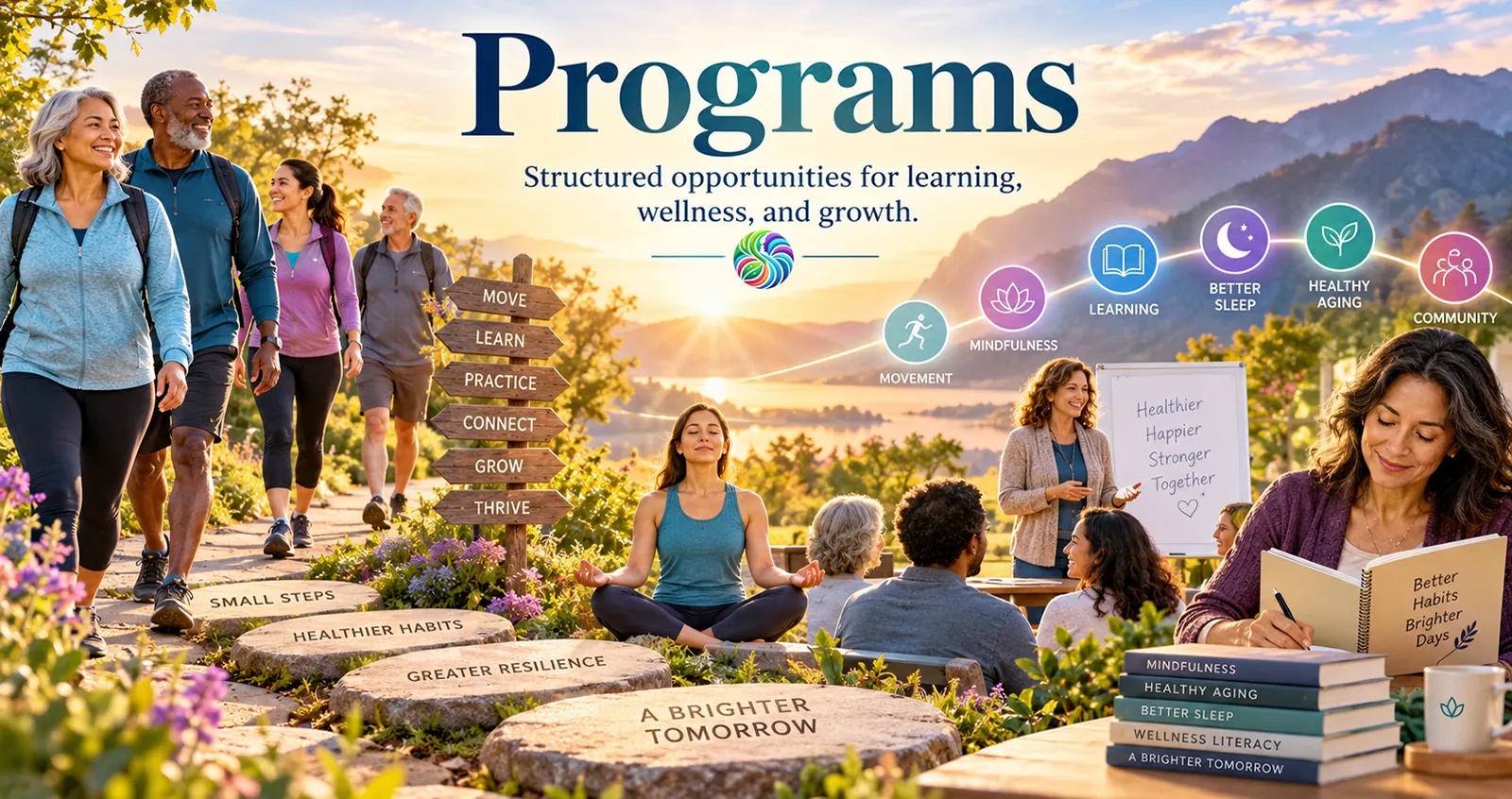
At Mind Body Works, we believe wellness education becomes most valuable when people have the opportunity to learn, practice, reflect, and apply what they discover to everyday life. Our Programs are designed to create that opportunity.
Each Mind Body Works Program is a structured multi-week learning experience built around an important dimension of whole-person well-being. Rather than offering quick fixes or overwhelming participants with unrealistic expectations, our programs focus on practical education, guided experiences, achievable steps, and sustainable habits that can continue long after the final session.
Across six to eight weeks, participants can explore subjects such as whole-person wellness, healthy aging, mindfulness, resilience, movement, stress recovery, and behavior change. Depending on the program, sessions may include live instruction, guided exercises, reflection activities, downloadable resources, educational materials, group discussion, and practical weekly actions.
The programs are designed for real people living real lives. You do not need to arrive with perfect habits, extensive knowledge, or previous experience. You simply need curiosity, a willingness to participate, and an interest in creating positive change.
Bringing the Different Dimensions of Well-Being Together
Our signature Whole-Person Wellness Program introduces participants to a broader understanding of health—one that recognizes that movement, nutrition, sleep, stress, emotional well-being, relationships, purpose, learning, and personal growth continually influence one another.
Over eight weeks, participants explore these dimensions individually while learning how they fit together.
Rather than trying to improve every area of life simultaneously, the program helps participants identify where change may be most meaningful and choose realistic actions that fit their circumstances.
Someone may discover that improving sleep gives them more energy to exercise. Another participant may recognize that social connection has been missing from their wellness routine. Someone else may realize that stress, rather than motivation, has been making healthier habits difficult to maintain.
The benefit is greater self-awareness and perspective.
Participants leave with a clearer understanding of their personal wellness priorities and a practical plan for continuing forward.
This is an ideal starting point for anyone who wants to see the larger picture of well-being rather than focusing on one isolated health goal.
Building Capability, Independence, and Engagement for the Years Ahead
Healthy aging is not simply about avoiding illness. It is about preserving the ability to move, think, participate, connect, and continue doing the things that make life meaningful.
The eight-week Healthy Aging: Strength for Life program focuses on the capabilities that can support quality of life across the years ahead.
Participants explore strength and resistance training, walking, mobility, balance, nutrition, brain health, sleep, recovery, social connection, lifelong learning, and purpose.
The emphasis is positive and forward-looking.
Instead of approaching aging primarily through decline, the program asks:
What can we continue to strengthen? What can we protect? What can we still learn, build, and enjoy?
Participants gain a better understanding of why muscle strength, balance, regular movement, cognitive engagement, meaningful relationships, and continued participation in life become increasingly valuable as we grow older.
The program is especially appropriate for adults who want to remain active and independent while developing habits that support long-term function and vitality.
Bringing Greater Awareness and Calm Into Ordinary Moments
Mindfulness does not require hours of meditation, a silent retreat, or an entirely different lifestyle.
It can begin with something much simpler: learning to pay attention.
The six-week Mindfulness for Everyday Life program introduces mindfulness in an accessible and practical way.
Participants explore breath awareness, focused attention, observing thoughts, body awareness, mindful movement, responding to stress, and incorporating short moments of mindfulness into daily routines.
Practices may take only a few minutes and can be used while walking, preparing for sleep, beginning the day, taking a break, or moving through a stressful situation.
The benefit is not learning how to eliminate every distracting thought.
It is developing greater awareness of what is happening in the present moment and becoming more intentional about how we respond.
For people who have always been interested in mindfulness but thought meditation seemed complicated or intimidating, this program offers a welcoming place to begin.
You do not have to become a meditator to become more mindful.
Turning Good Intentions Into Sustainable Routines
Most people already know at least a few things they would like to do more consistently.
Exercise more. Sleep earlier. Walk every day. Eat better. Read more. Spend less time scrolling. Practice mindfulness. Drink more water.
Knowing what we want to do is often easier than actually doing it consistently.
The six-week Better Habits, Better Life program explores the behavioral science behind lasting change.
Rather than relying on willpower alone, participants learn how habits are influenced by cues, repetition, environment, convenience, motivation, identity, and realistic expectations.
The program emphasizes small changes that can survive real life.
Participants learn how to make desired behaviors easier, reduce friction, create supportive environments, recover from lapses, and avoid the all-or-nothing thinking that often causes people to abandon otherwise valuable goals.
The objective is not perfection.
It is consistency.
By the end of the program, participants develop a personalized habit system designed around their own goals, routines, and circumstances.
Because nearly every wellness goal ultimately depends on repeated behavior, the lessons from this program can extend into fitness, nutrition, sleep, mindfulness, productivity, and personal growth.
Developing the Capacity to Adapt, Recover, and Grow
Life inevitably brings uncertainty, disappointment, disruption, and periods when circumstances do not unfold as planned.
Resilience does not mean remaining unaffected by those experiences.
It means developing the ability to respond, adapt, recover, seek support, and continue moving forward.
The six-week Resilient Mind program explores the psychological and behavioral skills that can strengthen resilience over time.
Participants learn about the stress response, emotional regulation, mental flexibility, perspective, confidence, self-compassion, social support, and learning from setbacks.
An important theme throughout the program is that resilience is not simply positive thinking.
It does not require denying difficult emotions or pretending that challenges are easy.
Instead, resilience grows through skills, experience, relationships, reflection, and the ability to adjust when circumstances change.
Participants are encouraged to recognize strengths they may already possess while developing additional tools they can draw upon during future challenges.
The goal is not to promise a life without adversity.
It is to help people feel better equipped to meet adversity when it arrives.
Building a Body That Supports the Life You Want to Live
Movement is one of the foundations of physical well-being, but exercise does not have to be extreme, competitive, or complicated to be valuable.
The eight-week Move for Life program helps participants understand how walking, strength, mobility, balance, flexibility, and everyday activity contribute to lifelong physical function.
Instead of focusing on appearance or athletic performance, the program focuses on capability.
Can you move comfortably through your day?
Can you get up, carry things, climb stairs, walk confidently, maintain balance, and continue participating in activities you enjoy?
Participants explore walking, functional strength, mobility, balance, reducing prolonged sitting, recovery, and developing a sustainable personal movement routine.
The program also demonstrates that physical activity is not limited to workouts.
Walking the neighborhood, taking movement breaks, gardening, climbing stairs, carrying groceries, playing with grandchildren, and remaining active throughout the day all contribute to a more movement-rich life.
The ultimate objective is simple:
Build and maintain a body that helps you continue participating fully in life.
Understanding Stress and Learning How to Recover
Stress is a normal part of being human.
The challenge arises when the mind and body remain under pressure without sufficient opportunities to recover.
The six-week Stress Less program helps participants understand what happens during the stress response and develop practical strategies for recognizing tension earlier and encouraging recovery.
Sessions explore breathing, relaxation, movement, mindfulness, sleep, mental downtime, boundaries, and individual stress patterns.
Participants experiment with several techniques rather than being told that one method works for everyone.
Some people may respond well to deliberate breathing. Others may find walking or gentle movement more restorative. Someone else may benefit from mindfulness, better evening routines, social connection, or simply recognizing the early signs that they need a break.
By the end of the program, participants build a personal Stress-Recovery Toolkit containing strategies they can use depending on the situation.
The program is educational and preventive rather than psychotherapy or individualized mental-health treatment, and it reinforces the importance of professional support when persistent or serious concerns require it.
Its central lesson is empowering:
We cannot remove every source of stress from life, but we can become better at recognizing when we need recovery—and learn healthier ways to respond.
Seven Programs, One Larger Purpose
Although each program explores a different aspect of well-being, they are connected by the same Mind Body Works philosophy.
Whole-Person Wellness helps participants see how the different dimensions of life fit together.
Healthy Aging helps preserve capability and engagement across the lifespan.
Mindfulness develops attention and awareness.
Better Habits turns intention into repeatable behavior.
The Resilient Mind strengthens adaptability and recovery.
Move for Life builds physical capability through everyday movement.
Stress Less develops practical strategies for managing pressure and supporting recovery.
Together, these programs create multiple entry points into one larger journey: learning how to understand ourselves better and translate that understanding into healthier, more purposeful living.
Participants do not need to take every program.
Some may begin with Whole-Person Wellness and discover that movement deserves more attention. Others may begin with Stress Less and later explore mindfulness. Someone interested in aging well may eventually participate in Move for Life or Better Habits.
Each program can stand on its own while also complementing the others.
Learn. Practice. Grow.
Mind Body Works Programs are intended to be more than information sessions.
They are opportunities to participate.
To ask questions.
To experiment with practical ideas.
To notice patterns.
To learn alongside others.
To make small changes.
And, over time, to discover what genuinely supports your own well-being.
There is no requirement to arrive already healthy, confident, disciplined, calm, fit, or experienced.
You begin where you are.
Our role is to provide knowledge, structure, encouragement, and practical tools that can help you determine where you would like to go next.
Whether your goal is to move more confidently, age with greater strength, develop better habits, become more mindful, build resilience, recover from stress more effectively, or simply understand your overall well-being more clearly, there is a Mind Body Works Program designed to help you begin.
Explore the programs. Choose the path that speaks to you. And take the next meaningful step toward a healthier, stronger, more aware, and more purposeful life.
1. Mind Body Works Whole-Person Wellness Program
An 8-Week Journey Toward Greater Awareness, Balance, and Well-Being
Whole-person wellness program teaches that sleep, movement, nutrition, stress, relationships, environment, purpose, and personal growth do not operate independently. They continually influence one another.
This eight-week signature program introduces participants to the major dimensions of well-being while helping them identify which areas of their own lives deserve the most attention. Rather than attempting to overhaul everything at once, participants learn to make thoughtful, realistic changes that can support several dimensions of wellness simultaneously.
Week 1 — Understanding Whole-Person Wellness
Participants are introduced to the idea that well-being is multidimensional and dynamic rather than a fixed state of perfect balance.
The session explores physical, mental, emotional, social, behavioral, environmental, and personal dimensions of wellness and how they influence one another.
Participants complete a private Whole-Person Wellness Check-In to identify areas of strength, areas needing attention, and one or two priorities for the weeks ahead.
Week 2 — Movement and Physical Well-Being
Explore why regular movement supports strength, mobility, cardiovascular health, brain health, independence, and overall functioning.
Participants examine walking, resistance exercise, mobility, balance, flexibility, and everyday movement without turning fitness into an all-or-nothing pursuit.
Weekly practice: identify one realistic way to move more consistently.
Week 3 — Nutrition and Everyday Energy
This session focuses on practical nutrition rather than restrictive dieting.
Topics include balanced eating, protein, fiber, hydration, whole foods, meal patterns, and how nutrition supports energy, muscle, healthy aging, and overall well-being.
Participants identify one sustainable nutrition improvement that fits their own lifestyle.
Week 4 — Sleep, Rest, and Recovery
Participants learn why recovery is as important as activity.
The session explores sleep routines, circadian rhythms, evening habits, light exposure, stress, exercise, and the role of intentional downtime.
Participants develop a simple personal Recovery Routine.
Week 5 — Stress and Emotional Well-Being
This week explains the mind-body stress response and explores emotional awareness, coping, relaxation, breathing, mindfulness, and appropriate support.
The emphasis is not on eliminating stress but on recognizing it earlier and responding more effectively.
Week 6 — Relationships and Social Connection
Explore how connection, belonging, friendship, family, community, and meaningful conversation contribute to well-being.
Participants assess whether their current routines create enough opportunities for genuine human connection.
Week 7 — Purpose, Learning, and Personal Growth
Wellness is not simply about preventing illness.
Participants explore lifelong learning, curiosity, purpose, creativity, meaningful goals, contribution, and continuing personal development at every stage of life.
Week 8 — Building Your Personal Wellness Plan
The final session brings everything together.
Participants create a realistic Personal Wellness Plan identifying priorities, supportive habits, environmental changes, potential barriers, and several actions they can continue after the program ends.
Program Features
Participants receive a Whole-Person Wellness Workbook, weekly reflection prompts, a wellness-dimensions self-assessment, practical action sheets, guided exercises, recommended Mind Body Works articles, and a final personal wellness roadmap.
You do not need to improve everything at once. Understanding how the pieces connect can help you decide where a meaningful change may have the greatest impact.
2. Healthy Aging: Strength for Life
An 8-Week Program for Strength, Mobility, Independence, and Lifelong Vitality
Healthy aging should not be defined only by what people hope to avoid.
This program emphasizes on what people can continue to build, protect, and enjoy as they grow older: physical capability, mobility, confidence, cognitive engagement, social connection, independence, and purpose.
The program is designed for adults approaching later life as well as older adults who want to remain active and engaged.
Week 1 — Rethinking Healthy Aging
Introduce the difference between chronological age and functional ability.
Explore strength, mobility, cognition, resilience, social connection, and purpose as important dimensions of aging well.
Participants identify what independence and quality of life mean personally to them.
Week 2 — Strength: Protecting Muscle and Function
Explain age-related muscle loss and why resistance training becomes increasingly important across adulthood.
Participants learn the principles of progressive strength training, major movement patterns, appropriate recovery, and why strong legs, hips, back, and upper body matter for everyday life.
Week 3 — Balance, Mobility, and Fall Prevention
Explore balance, coordination, mobility, posture, environmental hazards, and practical strategies for maintaining confidence while moving.
The goal is not fear of falling but preserving freedom of movement.
Week 4 — Walking and Everyday Activity
Participants examine the health value of walking, breaking up prolonged sitting, and making movement part of daily routines.
This session reinforces the idea that meaningful activity extends beyond formal workouts.
Week 5 — Nutrition for Strength and Healthy Aging
Discuss protein, hydration, fiber, overall dietary quality, and the relationship between nutrition, muscle maintenance, recovery, and energy.
The emphasis remains practical and non-dogmatic.
Week 6 — Brain Health and Lifelong Learning
Explore cognitive engagement, neuroplasticity, learning, creativity, social interaction, movement, and other behaviors associated with maintaining brain health.
Participants choose a new learning or creative challenge.
Week 7 — Sleep, Recovery, and Resilience
Examine how rest, recovery, stress, and emotional adaptability influence well-being later in life.
Participants develop strategies for balancing activity with adequate recovery.
Week 8 — Purpose, Connection, and Staying Engaged
The final session explores relationships, community participation, volunteering, hobbies, mentoring, purpose, and continuing personal development.
Participants create a Strength for Life Plan combining physical, cognitive, and social goals.
Program Features
This program includes mobility and balance demonstrations, beginner resistance-training education, walking plans, healthy-aging nutrition guides, fall-prevention checklists, brain-health activities, expert guest sessions, and a personal independence plan.
Healthy aging is not about resisting age. It is about protecting capability, remaining engaged, and continuing to grow.
3. Mindfulness for Everyday Life
A 6-Week Practical Introduction to Attention, Awareness, and Calm
Mindfulness can sometimes sound abstract, spiritual, or difficult. This program makes it all practical.
Participants learn that mindfulness is fundamentally about paying attention more intentionally to what is happening in the present moment—without requiring long meditation sessions or dramatic changes in lifestyle.
Week 1 — What Mindfulness Really Means
Introduce mindfulness, focused attention, awareness, and the difference between being present and operating automatically.
Participants begin with brief one- to three-minute awareness practices.
Week 2 — Learning to Work With the Breath
Explore breathing as an anchor for attention.
Participants practice simple breath awareness and learn how breathing can become a practical way to pause during stressful moments.
Week 3 — Observing Thoughts Without Following Every Thought
Participants learn that mindfulness does not require stopping thoughts.
Instead, the session explores noticing thoughts, emotions, and distractions without automatically reacting to them.
Week 4 — Mindful Movement and Body Awareness
Introduce walking meditation, body awareness, stretching, and mindful movement.
This helps participants understand that mindfulness does not have to mean sitting still.
Week 5 — Mindfulness During Stressful Moments
Explore how mindfulness can create a small space between stimulus and response.
Participants practice using brief pauses, breathing, and awareness during everyday tension.
Week 6 — Building Mindfulness Into Everyday Life
Participants identify natural opportunities for mindfulness during meals, walking, conversations, transitions, morning routines, or evening wind-down periods. By the end of the workshop, each participant creates a sustainable personal mindfulness practice.
Program Features
The program includes guided audio practices, short daily exercises, mindfulness journals, breathing instruction, optional guided meditation sessions, mindful walking activities, and downloadable practice cards.
You do not have to become a meditator to become more mindful.
4. Better Habits, Better Life
A 6-Week Behavioral Change Program for Building Habits That Can Last
People often know what they want to change. The difficult part is making the new behavior survive everyday life.
This program goes beyond motivation and teaches participants how habits develop, why good intentions often fade, and how behavior can be shaped by repetition, environment, cues, convenience, and realistic expectations.
Week 1 — How Habits Actually Form
Introduce the relationship among cues, behaviors, rewards, repetition, and context.
Participants identify one habit they want to build or strengthen rather than attempting multiple major changes.
Week 2 — Start Smaller Than You Think
Explore why overly ambitious goals frequently collapse.
Participants learn how to create a minimum viable habit—a version small enough to complete even on difficult days.
Week 3 — Design the Environment
This week examines friction.
How can the desired behavior become easier? How can unwanted behaviors become less convenient?
Participants redesign one element of their physical or digital environment to support their goal.
Week 4 — Motivation, Consistency, and Identity
Participants learn why motivation naturally fluctuates and why relying on motivation alone is unreliable.
The session explores consistency, self-perception, and becoming the kind of person who performs the desired behavior repeatedly.
Week 5 — Lapses Without Abandonment
Missing a workout, overeating, sleeping poorly, or abandoning a routine for several days does not need to become failure.
Participants learn recovery strategies and how to return to a habit without guilt or an all-or-nothing mentality.
Week 6 — Building a Habit System for Real Life
Participants create a personal habit plan incorporating cues, environment, scheduling, accountability, realistic goals, and relapse strategies.
The workshop emphasises on creating something that can survive busy weeks, vacations, stress, and ordinary disruption.
Program Features
This workshop includes a Habit Builder Workbook, weekly behavior experiments, habit tracking templates, environmental-design exercises, implementation-intention worksheets, and a 30-day continuation plan.
The best habit is not the most impressive one. It is the one you can continue.
5. The Resilient Mind
A 6-Week Program for Adaptability, Emotional Strength, and Recovery
Resilience is sometimes portrayed as toughness—the ability to endure difficulty without being affected by it.
Resilience rather involves responding, adapting, recovering, learning, and continuing forward, often with the support of other people.
Week 1 — What Resilience Really Is
Participants explore resilience as a dynamic capacity rather than a personality trait that someone either possesses or lacks.
The session examines adaptation, recovery, stress, and the role of experience.
Week 2 — Understanding the Stress Response
Learn what happens mentally and physically under pressure.
Participants become more aware of personal stress signals and the difference between immediate stress and prolonged strain.
Week 3 — Emotional Regulation
Explore recognizing emotions, naming them, creating space before reacting, and using constructive coping strategies.
This is not about suppressing difficult emotions but responding to them more effectively.
Week 4 — Mental Flexibility and Perspective
Participants examine rigid thinking, uncertainty, reframing, and the ability to adjust expectations when circumstances change.
The emphasis is on changing direction without losing one’s values or larger goals.
Week 5 — Confidence, Setbacks, and Self-Compassion
Explore how confidence develops through experience rather than appearing before action.
Participants examine setbacks as information rather than permanent judgments of ability.
Week 6 — Relationships, Support, and Rebuilding
The final session examines the social side of resilience.
Participants identify supportive people and resources, lessons learned from previous challenges, and personal strategies they can use during future periods of difficulty.
Program Features
This workshop includes a resilience workbook, stress-pattern assessment, guided reflection exercises, perspective-shifting activities, coping-resource map, confidence-building exercises, and a personal resilience plan.
Resilience does not mean that difficulty leaves us unchanged. It means developing the capacity to adapt, recover, and continue growing through what life asks of us.
6. Move for Life: Strength, Mobility and Everyday Movement
An 8-Week Program for Building a Body That Supports Everyday Living
This program is different from a fitness challenge.
There would be no emphasis on competition, appearance, extreme workouts, or athletic performance.
The objective would be to help people understand how movement supports function, confidence, independence, energy, and lifelong physical capability.
Week 1 — Movement Is More Than Exercise
Introduce the difference between structured exercise and everyday physical activity.
Participants assess their current movement patterns and identify realistic opportunities to move more.
Week 2 — Walking: The Foundation of Everyday Movement
Explore walking for cardiovascular health, endurance, mental well-being, and daily activity.
Participants develop an individualized walking goal appropriate to their starting point.
Week 3 — Strength for Everyday Life
Introduce resistance training and explain why muscle supports movement, metabolism, balance, bone health, and independence.
Participants learn basic movement patterns rather than following a rigid workout prescription.
Week 4 — Mobility and Flexibility
Clarify the difference between mobility and flexibility and why both can affect everyday function.
Participants learn gentle mobility concepts for major joints and movement patterns.
Week 5 — Balance and Stability
Explore balance, coordination, trunk stability, foot placement, and confidence.
The session is especially relevant to healthy aging but useful at every age.
Week 6 — Sit Less, Move More
Participants examine sedentary behavior and practical ways to interrupt long periods of sitting.
The program encourages movement snacks, standing, walking breaks, stairs, household activity, and active transportation where appropriate.
Week 7 — Recovery and Sustainable Training
Explore rest, soreness, sleep, hydration, progressive training, and why more exercise is not always better.
Participants learn to distinguish productive challenge from unnecessary overexertion.
Week 8 — Creating Your Movement Lifestyle
Participants build a personalized weekly movement plan combining walking, strength, mobility, balance, and everyday activity.
The goal of this workshop is to create something enjoyable and sustainable rather than temporarily ambitious.
Program Features
Move for Life includes live movement demonstrations, beginner and modified activity options, walking logs, mobility exercises, balance activities, resistance-training education, weekly movement challenges, and an individualized movement-planning worksheet.
This program will be offered in Beginner, Intermediate, and Healthy Aging versions based on demand.
Movement is not something we do only during exercise. It is one of the ways we maintain our ability to participate fully in life.
7. Stress Less: A Mind-Body Recovery Program
A 6-Week Program for Understanding Stress and Strengthening Recovery
Stress is part of life.
The goal of this program is not a promise to a stress-free existence. Rather, it helps participants understand what happens when stress builds, recognize their own patterns earlier, and develop a practical collection of recovery strategies.
Week 1 — Understanding the Mind-Body Stress Response
Participants learn what happens when the stress response is activated and how stress can influence breathing, muscle tension, attention, sleep, mood, and behavior.
Week 2 — Breath and Physiological Calm
Explore how breathing changes during stress and how deliberate breathing can support relaxation.
Participants practice several accessible breathing techniques and identify which feels most useful to them.
Week 3 — Movement as Stress Recovery
Discuss walking, stretching, physical activity, and releasing muscular tension.
Participants experiment with short movement breaks as a way of interrupting prolonged stress.
Week 4 — Mindfulness and Mental Recovery
Explore attention, rumination, worry, mental overload, and the value of creating periods of psychological downtime.
Participants learn short mindfulness and grounding practices.
Week 5 — Sleep, Boundaries, and Recovery
Examine how stress and sleep can reinforce one another.
Topics may include evening routines, downtime, workload boundaries, digital stimulation, recovery periods, and protecting restorative time.
Week 6 — Building Your Personal Stress-Recovery Toolkit
Participants identify their most common stress patterns and create a practical plan containing several options they can use depending on the situation.
The final objective is not one perfect relaxation technique but a personal recovery toolkit.
Program Features
This workshop includes guided breathing recordings, relaxation exercises, a stress-pattern journal, movement breaks, mindfulness practices, sleep and recovery worksheets, personal trigger mapping, and a final Stress-Recovery Plan.
We may not be able to remove every source of stress, but we can become better at recognizing when our systems are overloaded and supporting the return to recovery.
Learn, Practice and Grow With Us
Mind Body Works Programs are built around a simple principle: lasting well-being is strengthened when knowledge becomes practice and practice becomes part of everyday life. Our multi-week programs are designed to give participants the time, structure, and encouragement to explore important wellness concepts more deeply and apply them in realistic, meaningful ways.
Each program combines education with guided reflection, practical exercises, and achievable steps that build from week to week. Rather than asking participants to change everything at once, we focus on helping people better understand themselves, identify what matters most, and develop approaches they can continue long after the program has ended.
As Mind Body Works grows, our Programs will continue to expand across whole-person wellness, healthy aging, mindfulness, resilience, movement, stress recovery, behavior change, and other areas that support lifelong well-being. Some programs may be offered virtually, while others may include live workshops, community participation, expert guidance, downloadable resources, and opportunities for shared learning. What they will have in common is a commitment to making wellness education credible, practical, accessible, and sustainable.
Whether you want to strengthen your body, build healthier habits, become more mindful, navigate stress more effectively, develop greater resilience, or simply create a clearer direction for your well-being, our programs are designed to help you move from understanding to action.
Begin where you are. Learn what matters. Practice what works. Build something you can carry forward.
Put Wellness Into Action
Our programs are designed to turn knowledge, awareness, and healthy intentions into meaningful opportunities for learning, participation, and personal growth. Explore upcoming Mind Body Works events to discover ways to engage with our programs and community.
To learn more about the mission, values, and broader work that guide our programs and educational efforts, visit our About Us page.