













Most of us think of the senses as windows to the outside world.
We see light, hear sound, smell odors, taste food, and feel touch. But the brain is also receiving another stream of information almost continuously—signals coming from inside the body.
Your heartbeat speeds up.
Your stomach stretches after a meal.
Carbon dioxide rises in the blood and creates the urge to breathe.
Your bladder fills.
Body temperature changes.
Muscles begin to fatigue.
Blood pressure shifts when you stand.
The digestive system changes activity.
Some of these signals enter conscious awareness. Most do not.
The nervous system’s ability to sense, interpret, integrate, and help regulate this internal information is called interoception. The National Institutes of Health describes it as a broad body-brain process involving both signals traveling toward the central nervous system and regulatory signals traveling back toward the organs. NCCIH
Interoception helps answer one of the most basic questions the brain must continually address:
What is happening inside my body right now—and what, if anything, should I do about it?
That makes interoception much more than an interesting piece of neuroscience. It helps shape hunger, thirst, breathing, fatigue, physical comfort, emotional experience, stress responses, and our sense of when the body needs rest, food, movement, or attention.
Understanding it can also give us a more useful way to listen to the body—without assuming that every sensation is a warning or that becoming intensely focused on bodily signals is always better.
Interoception Is Your Inner Sensing System
Interoception is sometimes described as an internal sense.
Unlike vision or hearing, however, it is not tied to one sensory organ.
It gathers information from many systems at once.
Specialized receptors and sensory pathways monitor mechanical, chemical, hormonal, thermal, and other changes throughout the body. Interoceptive research includes signals from the cardiovascular, respiratory, gastrointestinal, endocrine, genitourinary, immune, and other physiological systems. PubMed
That information contributes to experiences as ordinary as:
feeling hungry before lunch,
realizing you need water,
noticing your heart pounding after climbing stairs,
feeling butterflies before an important conversation,
recognizing that you are becoming overheated,
or sensing that your body is tired even before you consciously decide to rest.
Yet interoception does not require conscious awareness.
Your brain regulates blood pressure, respiration, temperature, digestion, fluid balance, and countless other processes without waiting for you to notice them.
So interoception includes both what we consciously feel and the enormous amount of internal information the nervous system processes quietly in the background.
How the Body Sends Its Messages
The basic process can be understood without memorizing neuroanatomy.
Something changes inside the body.
Sensors detect that change.
Information travels toward the central nervous system.
The brain integrates it with other information.
The brain and body then adjust.
Several communication routes are involved.
The vagus nerve carries a large amount of sensory information from internal organs toward the brain, particularly from the chest and abdomen.
Spinal sensory pathways carry additional information.
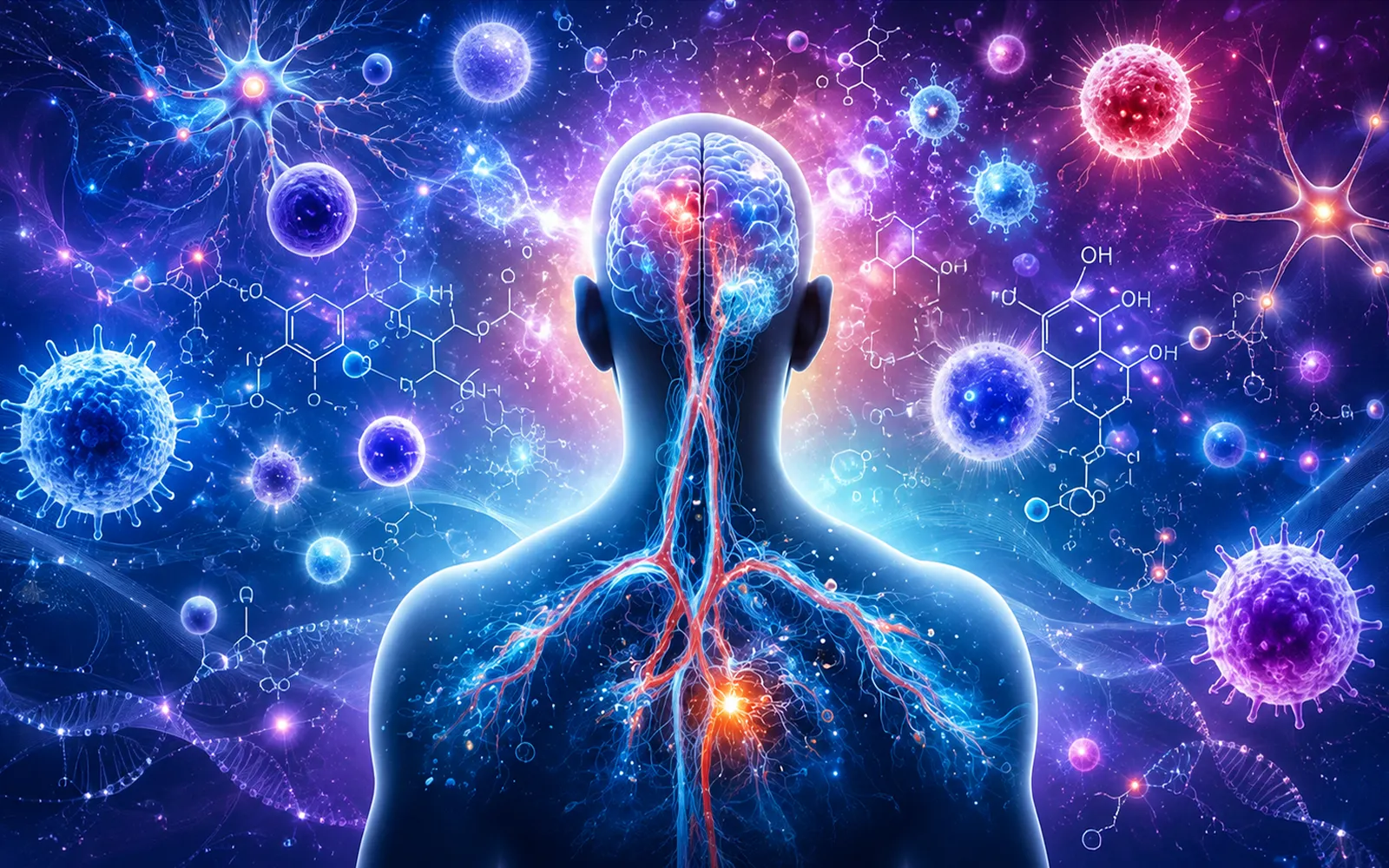
Hormones and immune molecules can also influence the brain through the circulation and other non-neural routes.
Once internal signals enter the central nervous system, they are processed through networks involving the brainstem and higher regions including the hypothalamus, thalamus, insular cortex, anterior cingulate cortex, and somatosensory areas. NCCIH
No single brain region therefore serves as the body’s simple “interoception center.”
It is a network.
And importantly, communication goes both ways.
The brain does not merely listen to the organs.
It also sends regulatory signals back.
If blood pressure falls when you stand up, the nervous system helps adjust heart rate and blood-vessel tone.
If body temperature rises, the body can increase sweating and blood flow near the skin.
If carbon dioxide rises, breathing is adjusted.
Interoception is therefore better understood as a continuing conversation between brain and body rather than a stream of alerts traveling in only one direction.
The Brain Does Not Simply Read the Body Like a Gauge
This is one of the most important ideas in interoception.
A bodily sensation is not always a simple measurement with one meaning.
Consider a fast heartbeat.
It could mean:
you just climbed a hill,
you drank a large amount of caffeine,
you are excited,
you are frightened,
you are overheated,
or your body is responding to illness.
The heart signal itself is only part of the information.
The brain also considers context.
Where are you?
What were you doing?
What were you expecting?
What other sensations are present?
What has happened in similar situations before?
Current models of interoception therefore emphasize that the brain integrates and interprets internal signals rather than merely detecting them. It also anticipates bodily needs and continuously compares incoming information with expectations about what the body is likely to require. PubMed
This helps explain why the same physical sensation can feel very different in different situations.
A pounding heart during exercise may feel satisfying.
The same pounding heart while sitting quietly may feel alarming.
The signal matters.
But so does the interpretation.
Why Interoception Is Essential for Staying in Balance
The body constantly tries to keep important physiological variables within workable ranges.
Temperature cannot wander indefinitely.
Blood glucose must be regulated.
Fluid and electrolyte balance matter.
Oxygen and carbon dioxide need to remain within narrow limits.
Blood pressure must adjust as posture and activity change.
This internal regulation is often discussed through the concepts of homeostasis and allostasis.
Homeostasis refers broadly to maintaining physiological stability.
Allostasis emphasizes something equally important: the body often maintains stability by anticipating changing demands and adjusting before a crisis occurs.
Interoception supplies information that helps make those adjustments possible.
Thirst encourages us to replace fluid.
Hunger helps regulate energy intake.
Breathlessness can signal increasing respiratory demand.
Fatigue can influence whether we continue exerting ourselves.
Temperature sensations encourage us to seek warmth or cooling.
The body does not need conscious thought to regulate all of these systems, but conscious sensations can become part of the behavioral solution.
You feel thirsty.
You drink.
The internal state changes.
The signals change.
The brain updates its assessment.
That is interoception functioning in ordinary life.
Hunger and Fullness Are Interoceptive Experiences
Eating provides an especially familiar example.
Hunger is not generated by one empty-stomach switch.
The brain integrates signals related to nutrient availability, hormones, gastrointestinal activity, previous food intake, circadian timing, learned expectations, sensory cues, and other information.
Fullness is similarly complex.
Stretch in the stomach and gastrointestinal signaling contribute, but so do the composition of the meal, eating speed, expectations, and brain systems involved in reward and energy regulation.
This is why becoming more aware of hunger and fullness can be useful without expecting those signals to behave like perfectly calibrated fuel gauges.
The practical objective is not:
I must eat only when a precise biological signal tells me to.
It is closer to:
Can I recognize what hunger and comfortable fullness tend to feel like in my own body before they become extreme?
Research examining mindfulness and hunger awareness suggests that attention to bodily sensations can affect some aspects of recognizing internal eating-related signals, although the evidence remains developing.
“Your body is continually giving your brain information. Learning to notice those signals calmly, place them in context, and respond appropriately can help turn body awareness into useful self-awareness.”
Breathing Is a Particularly Clear Window Into Interoception
Breathing is unusual because it operates both automatically and voluntarily.
You do not normally have to remember to breathe.
But you can deliberately slow, deepen, hold, or otherwise alter your breathing.
Internal sensors continuously monitor respiratory conditions, including changes associated with carbon dioxide and oxygen. Those signals contribute to the urge to breathe and help the nervous system regulate ventilation.
At the same time, breathing itself changes with physical exertion, emotional arousal, speech, posture, illness, and relaxation.
This makes breathing one of the easiest internal processes to notice directly.
You can often recognize the difference between:
quiet breathing at rest,
rapid breathing during exercise,
shallow breathing during tension,
and slower breathing as the body settles.
Learning to notice those changes without immediately judging them can provide useful information about your current physical and emotional state.
The Heart Is Talking Too
Most people are unaware of every heartbeat.
Yet cardiovascular information is constantly reaching the brain.
Changes in blood pressure and heart activity are monitored through sensory pathways that help the nervous system maintain circulation.
Sometimes the heart enters conscious awareness.
After exercise. During excitement. Following a sudden fright. While lying quietly at night. During stress.
Interoception research has historically used heartbeat perception as one way of studying internal sensing, although researchers now recognize that measuring interoceptive ability is considerably more complicated than simply asking whether someone can count their heartbeats accurately. Modern research increasingly treats interoception as multidimensional rather than as one single skill. PubMed
That matters practically because someone can be highly aware of one bodily system and less aware of another.
There is no single “interoception score” that captures everything happening inside a person.
Body Signals Help Shape Emotion
The relationship between interoception and emotion is particularly interesting.
Emotions are not produced solely by internal body sensations, but bodily signals appear to contribute significantly to emotional experience.
Consider anxiety. The heart accelerates. Muscles tense. Breathing changes. The stomach may feel unsettled. The hands may become sweaty.
Those physical changes become part of what the brain is interpreting as the experience unfolds.
The same principle applies to excitement, anger, calm, embarrassment, anticipation, and many other states.
A 2024 review of interoception and affect emphasizes that internal bodily information contributes to how emotional states are constructed and experienced, even though scientists are still working out exactly how signals from different organs are transformed into subjective feeling. PubMed
This provides a useful everyday insight:
Sometimes we recognize an emotional state partly because the body has already begun expressing it.
You may notice your shoulders tightening before consciously thinking:
I’m stressed.
Or feel your breathing settle before recognizing:
I’m calmer now.
Interoception can therefore provide an earlier window into changing emotional states.
Fatigue Is Also Information
Fatigue is often treated simply as something to overcome.
But the sensation of fatigue is also information.
During exercise, muscles, the cardiovascular system, respiration, temperature regulation, fuel availability, and the nervous system are all changing.
The brain integrates multiple signals to help regulate effort.
Outside exercise, fatigue can also reflect sleep loss, illness, stress, inadequate recovery, medication effects, nutrition, medical conditions, or many other influences.
This means fatigue deserves attention—but not automatic interpretation.
Feeling tired does not tell us exactly why we are tired.
That distinction applies throughout interoception:
A body signal is information. It is not always an explanation.
The next task is interpretation.
Interoception Is Not the Same as Hypervigilance
Once people learn about body awareness, it can be tempting to conclude that more attention to internal sensations must always be better.
It is not that simple.
Awareness can be helpful.
Constant surveillance can be exhausting.
A person can become very attentive to heartbeats, breathing changes, digestive sensations, or dizziness while interpreting those signals negatively or catastrophically.
Research on anxiety illustrates this distinction particularly well.
A 2024 meta-analysis of 71 studies found that anxiety was associated with greater negative evaluation of bodily sensations, increased attention to them, and greater self-reported sensitivity in several interoceptive domains. But that does not necessarily mean anxious individuals objectively perceive internal signals more accurately. PubMed
So healthy interoception should not be defined as:
Notice everything intensely.
A better goal is:
Notice useful signals, interpret them in context, and respond proportionately.
That is body awareness without body alarm.
The Most Useful Interoceptive Skill May Be Interpretation
Imagine noticing tension across your shoulders.
Several responses are possible.
Something is wrong with me.
I need to ignore this and keep working.
Or:
I’ve been sitting at this computer for three hours and rushing to finish something. My body may be telling me I need to move and reset.
The sensation is the same.
The interpretation changes what happens next.
Interoceptive skill therefore involves more than detecting sensations.
It includes distinguishing among:
sensation — What am I physically noticing?
context — What is happening around me?
meaning — What are the plausible explanations?
response — Does anything actually need to change?
This prevents interoception from becoming either neglect or overreaction.
A Practical Way to Listen to the Body
You do not need specialized equipment to become more familiar with internal signals.
A simple body check-in can be useful.
Pause for a moment and ask:
- What do I actually notice? Breathing, heartbeat, hunger, fullness, muscle tension, warmth, cold, fatigue, digestive sensations, or something else?
- Where do I notice it? Try describing location and quality before attaching a meaning to it.
- What was happening immediately beforehand? Exercise, eating, prolonged sitting, stress, caffeine, poor sleep, heat, conflict, or quiet rest?
- What does the body reasonably need? Food, water, movement, rest, slower breathing, cooling, a bathroom break—or perhaps no action at all?
- What happens after I respond? The change that follows can teach you something about the original signal.
The point is not to analyze yourself throughout the day.
It is to become somewhat better at recognizing recurring patterns.
Over time, you may learn:
This is what hunger feels like before I become ravenous.
This is how my shoulders feel when stress is building.
This is the difference between normal exercise breathlessness and exertion that feels unusual for me.
This is how tired I feel after poor sleep compared with ordinary afternoon sluggishness.
That is practical interoception.
Try Separating Sensation From Story
One particularly useful habit is to describe the physical sensation before explaining it.
Instead of: I’m anxious.
Try first: My breathing is faster, my chest feels tight, and my hands feel warm.
Instead of: Something is wrong with my stomach.
Try first: I feel pressure and fullness in my upper abdomen after eating quickly.
Instead of: I’m completely exhausted.
Try this: My eyes feel heavy, concentration is difficult, and I slept five hours last night.
This does not mean the interpretation is unimportant.
It creates a brief space between what the body is signaling and what we assume the signal means.
That can improve clarity.
Sometimes the explanation becomes obvious.
Sometimes it remains uncertain.
And sometimes a concerning or persistent signal deserves professional evaluation rather than further self-analysis.
Exercise Can Be an Interoception Lesson
Physical activity provides an unusually clear opportunity to learn how internal signals change.
During exercise, notice:
- breathing rate,
- heartbeat,
- body temperature,
- sweating,
- muscular effort,
- thirst,
- and perceived fatigue.
Then notice what happens during recovery.
Breathing gradually slows.
Heart rate settles.
Heat dissipates.
Muscle sensations change.
This creates a useful reference point for recognizing normal physiological activation.
A pounding heart is not automatically danger.
Heavy breathing is not automatically anxiety.
Sweating is not automatically a problem.
Context changes meaning.
This is one reason understanding interoception can be reassuring as well as informative: it teaches us that strong body signals are sometimes exactly what a healthy body should produce in response to demand.
Mindfulness May Help—But Not in the Simplistic Way We Might Assume
Mindfulness practices often direct attention toward breathing, body sensations, tension, or other internal experiences.
A 2025 meta-analysis of 29 randomized trials involving more than 2,000 participants found that mindfulness-related interventions produced small-to-moderate improvements in self-reported interoception, with mindfulness-based programs showing the largest effects. PubMed
That sounds straightforward until we ask whether people actually become more objectively accurate at detecting bodily signals.
A separate 2025 meta-analysis of 41 studies found only a small association between mindfulness and objective measures of body awareness, with substantial uncertainty, methodological limitations, and variation among studies. PubMed
Together, these findings provide a more useful conclusion than simply saying meditation “improves interoception.”
Mindfulness may help change how people attend to and relate to bodily sensations, but scientists are still working out how much it changes objective sensory accuracy.
For everyday purposes, that distinction may be beneficial.
The goal does not need to be detecting every heartbeat.
It may be becoming better at noticing the body without immediately ignoring, judging, or fearing what is noticed.
Can Interoception Be Trained?
Probably to some degree—but this is an area where the science is still developing.
A 2024 experimental study found that interoceptive training was associated with changes in a brain network involving the anterior insular cortex, a region strongly implicated in integrating bodily information. Nature
Research on mindfulness, body-based practices, exercise, and other approaches also suggests that aspects of interoceptive awareness may be modifiable.
But researchers continue to debate how best to measure interoception and whether different training methods improve detection, interpretation, emotional regulation, or simply confidence in one’s body awareness. PubMed
So rather than promising to “strengthen your sixth sense,” a more defensible goal is:
Become more familiar with your body’s patterns and more skillful at interpreting them.
When Body Awareness Becomes Especially Useful
Interoception can be practically relevant in many ordinary situations.
Before stress becomes overwhelming
Recognizing a tightening jaw, elevated shoulders, altered breathing, or gastrointestinal discomfort can provide an earlier clue that stress is building.
That gives you more opportunity to respond before the experience becomes overwhelming.
During eating
Recognizing developing hunger and comfortable fullness can help eating become more responsive to physical needs rather than waiting until hunger becomes extreme.
During physical activity
Learning your normal patterns of exertion can help you pace activity and distinguish familiar exercise sensations from something that feels genuinely unusual.
During recovery
Fatigue, soreness, thirst, appetite, and changes in energy can help inform decisions about rest and activity.
During relaxation
Noticing breathing slowing, muscles releasing, and heart activity becoming less prominent can make relaxation less abstract.
Instead of simply thinking I should calm down, you begin recognizing what settling actually feels like in your own body.
But Body Signals Should Not Replace Medical Judgment
Interoception is useful because the body provides information.
It is not a diagnostic system.
Chest discomfort cannot be reliably classified as harmless simply because someone is highly body-aware.
Persistent fatigue cannot be diagnosed from its subjective quality.
Dizziness can have many causes.
Digestive sensations can range from normal responses to symptoms requiring medical evaluation.
And some serious medical problems may produce surprisingly subtle sensations.
The right lesson from interoception is therefore not:
Trust every sensation as a diagnosis.
It is actually:
Pay attention to meaningful changes, interpret them in context, and seek appropriate evaluation when symptoms are new, severe, persistent, or concerning.
Better Interoception Is Not About Becoming More Preoccupied With the Body
This may be the most important practical distinction.
A useful relationship with internal signals is neither disconnection nor obsession.
At one extreme, we can ignore the body until hunger becomes ravenous, stress becomes overwhelming, exhaustion becomes severe, or physical discomfort forces us to stop.
At the other extreme, we can monitor every heartbeat, digestive movement, breath, or small sensation and treat normal variation as evidence that something is wrong.
Interoceptive awareness works best somewhere between those extremes.
Notice.
Interpret.
Respond when appropriate.
Then continue living.
The aim is not constant internal monitoring.
It is better communication with the body when that information matters.
Learning the Language of Your Own Body
Interoception reveals something fundamental about human experience.
The brain is not sealed inside the skull, creating thoughts and emotions independently of the rest of us.
It is continually receiving information from the heart, lungs, gut, blood vessels, endocrine system, muscles, immune system, and other tissues.
Those signals help regulate basic physiology.
They also contribute to hunger, thirst, effort, fatigue, stress, emotion, motivation, and our moment-to-moment sense of how we feel.
Science is still working out exactly how those signals are encoded and interpreted, and there is no single measure that captures how “good” someone’s interoception is.
But we do not need to wait for every mechanism to be solved before drawing a practical lesson.
Your body is continually giving your brain information. Learning to notice those signals calmly, place them in context, and respond appropriately can help turn body awareness into useful self-awareness.
You do not need to hear every message.
You do not need to obey every sensation.
And you certainly do not need to become preoccupied with what is happening inside you.
The goal is simpler:
Know your body’s normal patterns well enough to recognize when it is asking for food, water, movement, rest, recovery, calm—or attention.
That is interoception at its most practical.
Health and Mental Wellness Disclaimer
This article is intended for general educational purposes and is not medical or mental-health advice. Bodily sensations such as chest pain, shortness of breath, dizziness, persistent fatigue, significant digestive changes, fainting, or other new or concerning symptoms can have many causes and should not be interpreted solely through interoceptive awareness. Seek appropriate medical evaluation for severe, persistent, unexplained, or concerning symptoms.