














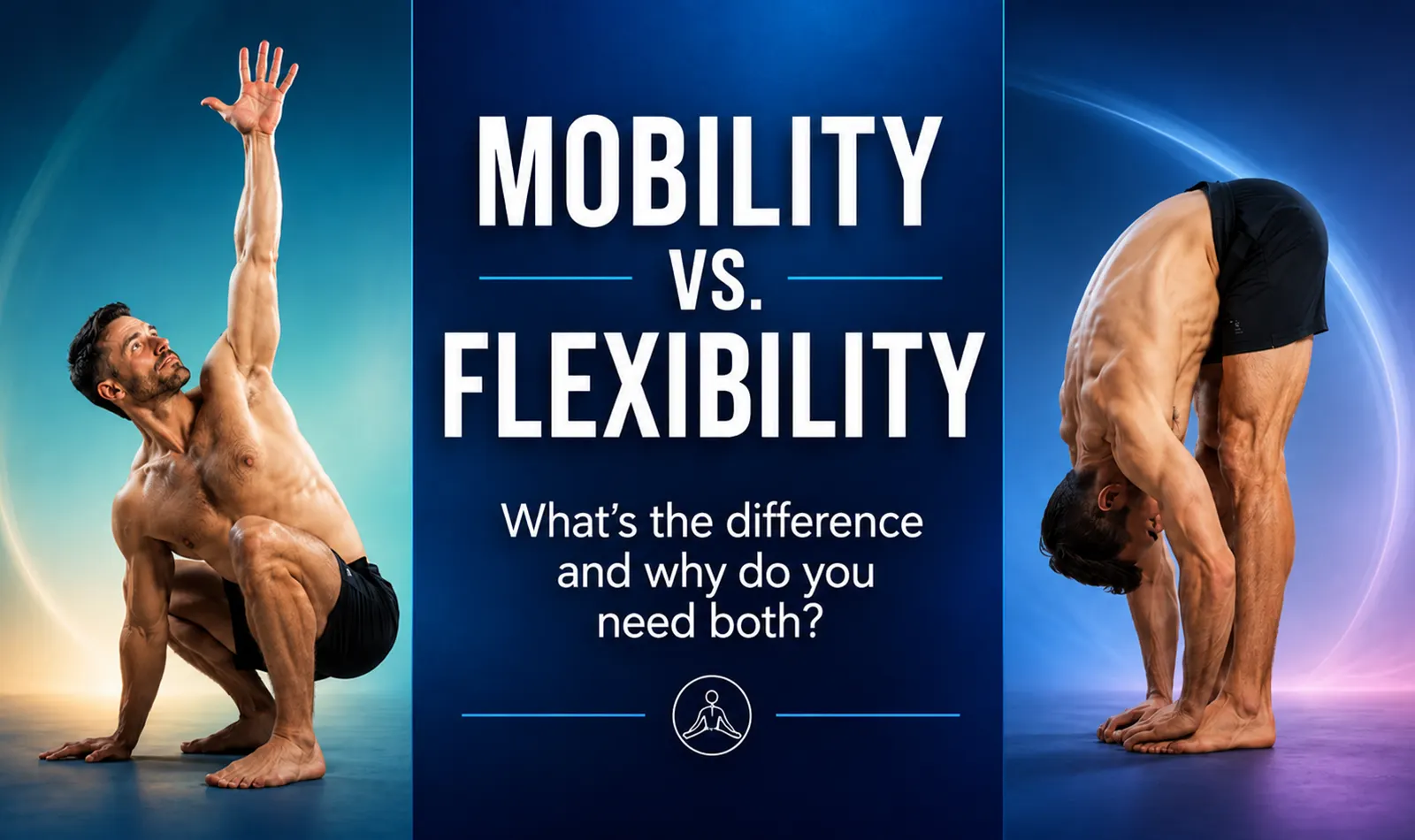
Mobility and flexibility are often used as though they mean the same thing. They are closely related, but they describe different aspects of how the body moves—and understanding that distinction can make exercise more effective.
Flexibility is primarily about the range of motion available to you. Mobility is about your ability to actively control and use that range.
Someone may be flexible enough to move a joint into a certain position when assisted, yet lack the strength or control to reach that position independently. Another person may be strong and coordinated within a limited range but unable to move comfortably beyond it.
For healthy, capable movement, we generally want both: enough available range to perform the movements life demands and enough strength and control to move through that range confidently.
Flexibility and Mobility Are Related—but Not Identical
Before going further, it helps to clarify the terminology.
In exercise science, range of motion, or ROM, describes how far a joint can move. Flexibility is one factor influencing that range, particularly the extensibility of muscles and other soft tissues surrounding a joint.
A 2026 sports-science review emphasized that flexibility and range of motion should not be treated as synonymous because ROM can also be influenced by anatomy, joint structure, neural factors, and motor control.
The word mobility is used somewhat more broadly in fitness and rehabilitation than it is in research literature. In practical training, it usually refers to the ability to actively move a joint through useful ranges of motion with control, coordination, and stability.
One simple way to think about the distinction is:
- Flexibility: How much range is available?
- Mobility: How much of that range can you actively control and use?
The two overlap, but they are not interchangeable.
A Simple Example: The Hip
Imagine lying on your back while someone gently lifts your straight leg toward you.
If your leg can move relatively far with assistance, you may have good passive flexibility through the hamstrings and hip.
Now stand up and try to lift that same straight leg as high as possible without leaning backward or using momentum.
The range may be considerably smaller.
Why?
Your passive tissues may allow the position, but actively reaching it requires the nervous system to coordinate multiple muscles while maintaining strength and stability.
That gap between available range and controlled range helps illustrate the difference between flexibility and mobility.
“Flexibility gives your body access to movement. Mobility gives you the strength and control to make that movement useful.”
Pull Quote
Flexibility Creates Movement Options
Flexibility gives the body access to positions.
When muscles and surrounding tissues comfortably tolerate greater length, joints can often move through larger ranges. This can be important for everyday activities such as reaching overhead, bending toward the floor, turning, stepping over objects, or getting into and out of different positions.
The U.S. Physical Activity Guidelines note that flexibility activities help joints move through their range of motion and can make tasks requiring greater flexibility easier to perform.
Stretching remains one of the most direct ways to improve flexibility.
A major 2025 systematic review and meta-analysis involving 189 studies and 6,654 adults found that static stretching significantly improved flexibility both immediately and following repeated training. The greatest long-term benefits tended to occur in people who started with lower flexibility.
Flexibility therefore matters. But having access to a position does not automatically mean the body can control it.
That is where mobility enters the picture.
Mobility Adds Strength and Control
Mobility turns available movement into usable movement.
Consider a deep squat. Reaching the bottom position requires sufficient motion at the ankles, knees, hips, and other joints. But simply possessing enough flexibility is not sufficient.
You also need:
- muscular strength,
- balance,
- joint stability,
- coordination,
- body awareness,
- and nervous-system control.
A person may be able to sit passively in a deep squat while holding onto something but struggle to lower into or rise from the same position without assistance.
The flexibility is present. The active control is not yet fully developed.
Mobility training seeks to reduce that gap.
Why Mobility Matters in Everyday Life
Daily life rarely places us in passive positions.
We reach, bend, twist, squat, step, climb, lift, carry, and change direction while controlling our own body weight and sometimes additional loads.
Getting something from a low cabinet requires more than flexible hips. It requires the strength and coordination to lower the body and stand again.
Reaching onto a high shelf requires shoulder range of motion, but also muscular control of the shoulder blade and trunk.
Stepping over an obstacle requires adequate hip motion along with balance and single-leg stability.
This is why mobility connects so naturally with functional fitness: it helps translate physical capacity into useful movement.
Flexibility Without Control Has Limitations
It is possible to have substantial flexibility without equivalent stability or strength.
Gymnasts and dancers provide an obvious example. Their sports demand exceptional ranges of motion, but those ranges become useful only because they also develop tremendous muscular control.
For the average person, extreme flexibility is rarely necessary.
The goal is not to maximize range at every joint. It is to have enough range for your activities and enough control to use it well.
More movement is not automatically better movement.
Anatomy differs from person to person, and some joints are naturally capable of greater motion than others. Healthy movement therefore should not be judged by whether everyone can achieve identical positions.
The objective is useful, comfortable, controlled range—not maximum range for its own sake.
Mobility Without Enough Flexibility Has Limits Too
The opposite problem can also occur.
If the available range itself is restricted, strength and coordination cannot fully compensate.
Limited ankle motion, for example, may alter how someone performs a squat. Limited shoulder range may make overhead movements difficult. Restricted hip movement can influence how someone bends, lunges, or steps.
In situations like these, improving flexibility may create additional movement options.
Once that range becomes available, strengthening and controlling it helps transform the new range into functional mobility.
This leads to an important principle:
Flexibility can create the range. Mobility training teaches the body what to do with it.
Stretching Is Not the Only Way to Improve Range of Motion
One of the more interesting developments in modern exercise research is that stretching is no longer considered the only tool for improving joint range of motion.
Resistance training performed through appropriate ranges can improve flexibility as well.
A 2023 systematic review and meta-analysis of 55 studies found that resistance training increased joint range of motion, with improvements that were not significantly different from those produced by stretching programs.
A newer 2025 meta-analysis also found significant improvements in joint flexibility from resistance training, although the researchers noted substantial variation among the included studies.
This gives us a broader way of thinking about mobility training.
A controlled deep squat, split squat, Romanian deadlift, overhead press, or other resistance exercise performed through an appropriate range can simultaneously challenge strength and range of motion.
In other words, strength training and mobility training do not always have to occur in separate worlds.
Active Mobility Training Builds Usable Range
Mobility exercises typically involve moving actively through a joint’s range rather than simply relaxing into a stretch.
Examples might include:
- controlled hip circles,
- shoulder rotations,
- deep squat transitions,
- active leg raises,
- lunges with rotation,
- ankle mobility drills,
- controlled spinal rotations,
- and slow movement through progressively larger ranges.
The objective is not simply to “loosen” the body.
Good mobility work asks the muscles and nervous system to own the position.
Moving slowly and deliberately through a range can help develop coordination, strength, and awareness at positions that may otherwise receive little training.
Static Stretching Still Has an Important Role
Because mobility training has become popular, stretching is sometimes portrayed as outdated or unnecessary. The evidence does not support such a broad conclusion.
Static stretching is highly effective for increasing flexibility. The large 2025 review mentioned earlier found meaningful improvements from both individual stretching sessions and longer-term stretching programs.
The key is using stretching for the right purpose.
Static stretching may be particularly useful when you want to gradually increase the available range of a specific muscle group or joint. It can be incorporated after training, during separate mobility sessions, or at another convenient time.
It does not have to dominate a fitness program, but it remains a legitimate and effective tool.
Dynamic Mobility Is Often Better Before Exercise
Before a workout, the goal is usually not simply to become more flexible. It is to prepare the body for movement.
That makes dynamic mobility particularly useful.
A dynamic warm-up may include controlled squats, lunges, arm movements, leg swings, step patterns, or progressively larger movements that resemble the activity about to be performed.
Recent research continues to support dynamic warm-ups for preparing the musculoskeletal and nervous systems for physical performance.
Dynamic stretching has also been shown to produce small immediate improvements in flexibility.
A practical approach is therefore:
Before training: emphasize dynamic movement and mobility.
For dedicated flexibility work: use static stretching when appropriate.
The two methods serve different purposes and can coexist comfortably within the same program.
You Do Not Need an Hour-Long Mobility Routine
One reason mobility work sometimes becomes unnecessarily complicated is the enormous number of drills promoted online.
It is easy to believe that every workout needs twenty minutes of stretching, foam rolling, joint circles, bands, and corrective exercises before the actual training can begin.
For most healthy people, that is unnecessary.
Mobility work is most valuable when it addresses specific limitations that matter to the activities you perform.
If your ankles prevent you from squatting comfortably, focus there. If reaching overhead is difficult, shoulder and upper-back mobility may deserve attention. If your hips feel restricted during lunges, work on the range needed for that movement.
A few well-selected exercises performed consistently can be far more useful than an elaborate routine with no clear purpose.
Strengthen the Range You Gain
Perhaps the most important principle in mobility training is this:
Do not only enter new ranges—develop strength within them.
Suppose regular stretching gradually improves your hip range. That new range becomes more useful when exercises train the surrounding muscles to produce and resist force there.
This might mean progressing from a supported position to an unsupported one, increasing the depth of a squat gradually, adding light resistance, or performing slow controlled repetitions.
The goal is to make previously unfamiliar positions increasingly familiar to the nervous system.
Over time, the body learns that the range is not simply available—it is safe, controlled, and useful.
Mobility Becomes More Important as We Age
Maintaining comfortable movement takes on greater importance over time.
Inactivity, injury, reduced strength, joint changes, and habitual movement patterns can gradually decrease the ranges we regularly use. When certain positions disappear from everyday life, the body receives fewer opportunities to maintain them.
This is one reason physical activity guidelines encourage older adults to maintain sufficient flexibility for both regular exercise and activities of daily living. They also emphasize multicomponent training that combines strength, balance, aerobic exercise, and functional movement.
The objective is not exceptional flexibility.
It is maintaining the ability to reach, bend, turn, stand, walk, climb, and move confidently through the ranges everyday life requires.
Mobility, like strength, can be thought of as part of physical independence.
A Balanced Approach to Mobility and Flexibility
For most people, an effective approach does not require choosing between stretching and mobility exercises.
Instead, combine them strategically.
Before Exercise
Use dynamic movements that progressively take the joints through the ranges required for the upcoming activity.
Examples might include bodyweight squats, walking lunges, arm circles, controlled rotations, or gentle leg swings.
During Strength Training
Perform exercises through the largest comfortable range you can control with good technique.
Gradually increasing controlled range can develop strength and movement capacity simultaneously.
After Training or Separately
Use static stretching for specific areas where greater flexibility would be useful.
Stretching does not need to be painful. Consistency is generally more valuable than aggressively forcing greater range.
Throughout Everyday Life
Continue using your movement capacity.
Squat, reach, walk, bend, rotate, climb stairs, get down to the floor, and change positions regularly when your abilities permit.
The ranges we continue to use are the ranges we give the body a reason to maintain.
Mobility Is Not About Becoming a Contortionist
Social media can create the impression that good mobility means performing extreme splits, deep backbends, or unusually complex movement drills.
For most people, that misses the point.
Mobility is individual and task-specific.
A runner, swimmer, weightlifter, tennis player, gardener, and 75-year-old who wants to remain independent may each need somewhat different ranges of motion.
The better question is not:
“Am I flexible enough?”
It is:
“Do I have the movement capacity required for the things I want to do?”
That turns mobility from a performance contest into something much more useful.
Build Range—Then Learn to Own It
Flexibility and mobility are partners.
Flexibility helps determine how much movement is available. Mobility reflects how effectively the body can access and control useful movement. Strength and coordination help turn that movement into real-world capability.
If flexibility is limited, targeted stretching and appropriately performed resistance training can help expand range of motion. If range exists but control is lacking, active mobility and strength work can help develop command over it.
Together, they allow movement to become freer, stronger, and more confident.
The ultimate goal is not simply to move farther.
It is to move well—and to maintain that ability throughout life.
Disclaimer
This article is intended for general educational purposes and is not a substitute for individualized medical, physical therapy, or exercise advice. Pain, persistent joint restriction, instability, or significant loss of motion may require evaluation by a qualified healthcare professional. Mobility and stretching exercises should be performed within comfortable, controlled ranges appropriate to the individual’s abilities.