










There is a familiar idea that learning belongs primarily to the young. We go to school, acquire the knowledge and skills needed for adult life, establish ourselves in work and family, and eventually settle into what we already know.
The human brain tells a more interesting story.
Although the way we learn changes with age, our capacity to acquire knowledge, develop skills, form new memories, and adapt to unfamiliar challenges does not simply disappear. Older adults may sometimes need more time or repetition when learning complex new material, but the brain retains an ability to change and respond to experience throughout life. The National Institute on Aging notes that older adults remain capable of learning new skills, forming new memories, and improving vocabulary and language abilities.
That makes lifelong learning more than a way to accumulate information. It can become a way of continuing to participate actively in our own development.
The Brain Is Not a Finished Product
For much of scientific history, the adult brain was viewed as relatively fixed. Development occurred early, the basic architecture became established, and adulthood was thought to bring comparatively little neurological change.
Research on neuroplasticity has transformed that picture.
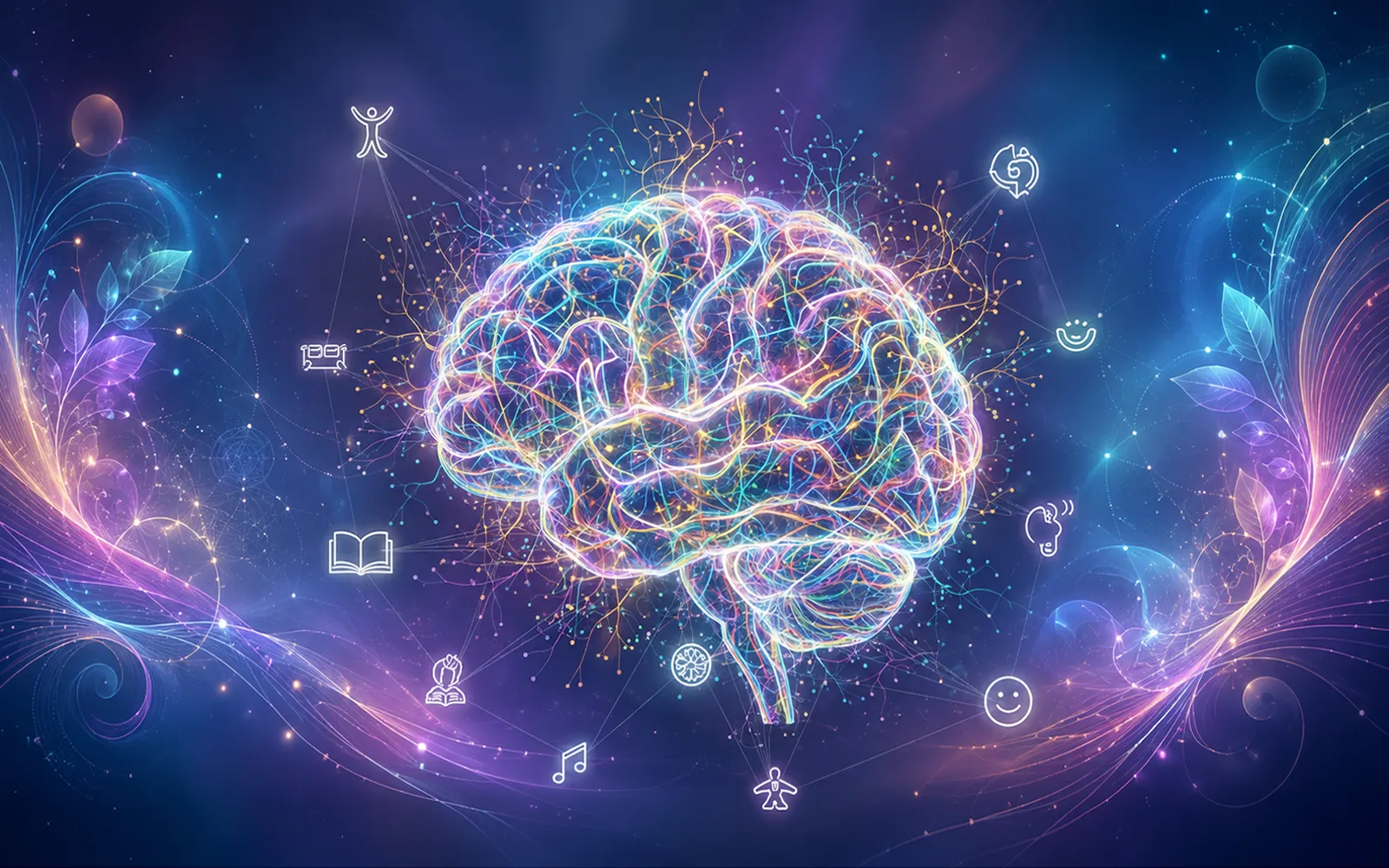
Neuroplasticity refers broadly to the brain’s ability to alter its functioning and organization in response to experience, practice, environmental demands, injury, and learning. This flexibility is particularly powerful during childhood, but it does not vanish when development ends. Adult brains continue to adapt, although the degree and speed of plasticity can differ substantially from what occurs earlier in life.
Learning is one of the experiences that places new demands on the brain. Mastering an unfamiliar piece of music, understanding a new technology, studying a language, learning photography, developing a craft, or exploring a new field of knowledge requires networks involved in attention, memory, perception, reasoning, and movement to work in new combinations.
The brain does not need to remain unchanged in order for us to remain ourselves. In fact, our ability to change is part of what allows us to remain capable in a changing world.
Learning Changes With Age—but It Does Not End
Healthy aging can bring genuine changes in cognition. Processing speed may slow. Multitasking can become more difficult. Recalling a name or learning complicated material may sometimes take longer.
At the same time, aging does not affect every cognitive ability in the same way.
A 2025 systematic review examining learning across healthy adulthood found that age-related changes were more pronounced in areas such as some fluid abilities and explicit learning and memory, while crystallized abilities—the knowledge and skills accumulated through experience—and some forms of implicit learning showed greater stability.
This helps explain something many people recognize in everyday life. A younger person may sometimes learn a new procedure more quickly, while an older person may bring a much larger framework of experience, vocabulary, judgment, pattern recognition, and context to the same problem.
Learning later in life therefore need not look exactly like learning at 20.
It may be slower in some respects and richer in others.
The important distinction is between changing capacity and disappearing capacity. The first is part of normal development across the lifespan. The second is a misconception.
“Growing older may change the way we learn, but it never requires us to stop discovering what we can become.”
Why Challenge Matters
Not every mentally active experience asks the same thing of the brain.
Repeating a familiar activity can certainly be enjoyable and valuable, but learning something genuinely new introduces uncertainty. We make mistakes. We search for patterns. We have to concentrate. At first, what eventually becomes automatic requires deliberate effort.
That effort is part of learning.
One influential study known as the Synapse Project asked older adults to spend several months learning cognitively demanding skills such as digital photography and quilting. Participants engaged intensively with unfamiliar material rather than simply performing familiar mental activities. The groups learning demanding new skills showed improvements in episodic memory compared with less cognitively demanding conditions. The study does not establish that any particular hobby protects the brain, but it illustrates an important idea: novel, sustained learning may engage cognition differently from simply staying occupied.
This does not mean that every activity has to be difficult or that personal growth requires turning life into a constant test. Challenge is most useful when it is substantial enough to require adaptation but meaningful enough that we want to continue.
Lifelong Learning Can Take Many Forms
Learning does not require returning to school or pursuing another degree. Formal education is one path, but curiosity can be exercised almost anywhere.
Meaningful lifelong learning might include:
- learning to play or returning to a musical instrument
- studying a language, history, philosophy, science, or another unfamiliar subject
- developing photography, painting, woodworking, gardening, cooking, or other practical skills
- learning new software or becoming comfortable with changing technology
- taking a class that requires active participation and practice
- reading deeply about subjects outside one’s usual interests
- joining a discussion group where ideas are examined rather than simply exchanged
- learning a new physical skill such as dancing or a different form of movement
What matters is not collecting activities for the sake of appearing busy. The deeper principle is active engagement with something we do not yet know how to do.
That moment of not knowing is not evidence that we are incapable. It is the starting point of learning.
More Than Mental Exercise
The value of learning also extends beyond cognitive performance.
Learning changes our relationship with the future.
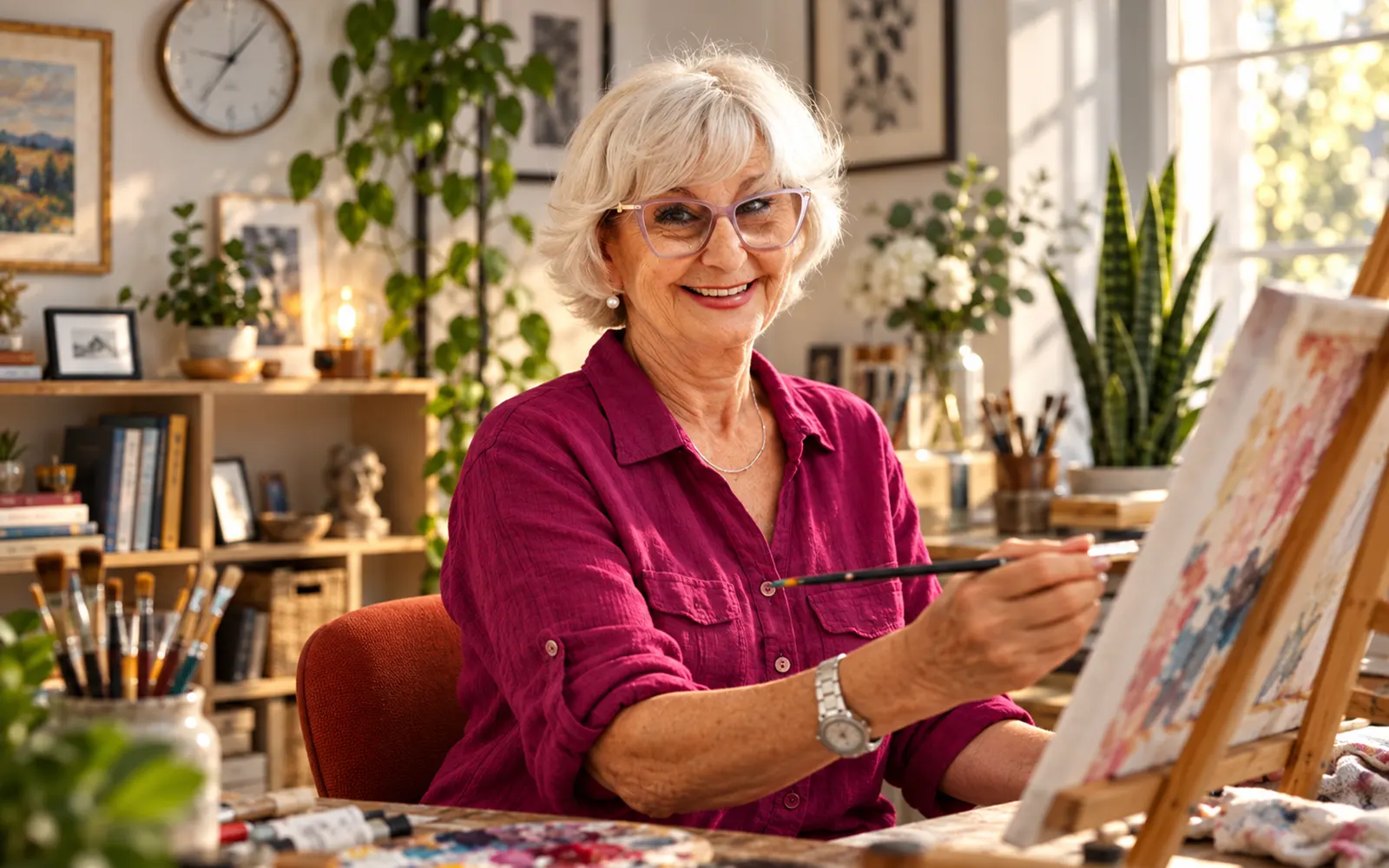
When people remain willing to become beginners, they continue giving themselves access to experiences they have not yet had, people they have not yet met, and abilities they have not yet developed. A person who begins painting at 60, studies astronomy at 70, learns digital photography at 80, or takes up a musical instrument later in life is doing more than exercising memory.
They are adding possibilities to their life.
This is one reason lifelong learning belongs naturally within Personal Growth. Growth is not simply the process of improving what we already do well. Sometimes it means entering territory where we are temporarily unskilled.
Being a beginner can be uncomfortable because competence is reassuring. We know the vocabulary. We know the rules. We know what to expect.
Learning asks us to surrender some of that certainty.
Yet it is precisely there—between what we already understand and what we are beginning to understand—that development occurs.
Learning, Cognitive Reserve, and Brain Health
Researchers studying aging also use the concept of cognitive reserve to help explain why people with similar age-related or neurological changes can sometimes differ considerably in their cognitive functioning.
Cognitive reserve is not a physical reserve stored in one location in the brain. It is a theoretical framework describing the brain’s capacity to cope with changes or pathology through flexible and efficient use of cognitive processes and neural networks.
Education, intellectually demanding work, social engagement, and cognitively stimulating activities across life have all been studied as potential contributors.
A 2024 systematic review and meta-analysis found that indicators of greater cognitive reserve across early, middle, and later life were associated with lower dementia risk. However, much of this evidence is observational. It cannot establish that taking classes or learning a new hobby by itself will prevent dementia, and mentally stimulating activities should not be treated as a guaranteed protective intervention.
That qualification matters.
The value of lifelong learning does not depend on promising that it will prevent disease. Learning already has considerable value because it gives the brain meaningful work to do while expanding knowledge, capability, confidence, participation, and connection with the world.
Curiosity Is a Form of Engagement With Life
Children ask questions almost continuously because so much of the world is new to them.
Adulthood brings expertise, but expertise can sometimes reduce the number of questions we ask. Familiarity makes life easier, yet familiarity can also encourage us to move through parts of life automatically.
Curiosity interrupts that automatic mode.
Why does this work?
How did that happen?
What would it be like to learn this?
What have I misunderstood?
What else might be possible?
These questions are small invitations to growth.
A curious person does not need to know everything. In many ways, curiosity begins with becoming comfortable enough to admit that we do not know.
That attitude becomes increasingly valuable in a world where knowledge and technology continue changing. Lifelong learning is not simply preparation for a career. It is a form of adaptability.
You Do Not Have to Learn the Way You Once Did
One obstacle to lifelong learning is the expectation that we should perform as we did decades earlier.
A person may begin a language and become frustrated because vocabulary does not stick as quickly as expected. Someone learning technology may need to repeat a process several times. Another person may notice that concentrating for long periods requires more effort than it once did.
None of these experiences necessarily means that learning has become impossible.
The National Institute on Aging notes that older adults may require more time to learn certain new tasks but can still perform successfully once given sufficient time.
A more productive question therefore may not be, “Can I still learn as quickly as I once did?”
It may be, “How do I learn best now?”
That shift replaces comparison with adaptation.
Learning can be broken into smaller sessions. Difficult material can be revisited. New information can be connected to existing knowledge. Skills can be practiced instead of merely read about. Rest can be built into the process.
The goal is not to recreate a younger brain. It is to continue making effective use of the brain we have now.
There Is No Final Version of You
Personal growth is sometimes imagined as a destination: become disciplined enough, knowledgeable enough, confident enough, accomplished enough—and eventually the work is finished.
Life rarely behaves that way.
Circumstances change. New technologies appear. Relationships evolve. Careers shift. Bodies age. Perspectives deepen. Problems that once seemed important become smaller, while questions we never considered begin to matter.
We continue encountering situations for which our previous knowledge is incomplete.
Lifelong learning gives us a constructive response to that reality.
We can remain teachable.
We can continue building skills that did not exist in our earlier lives. We can revise ideas when better information becomes available. We can explore subjects simply because they awaken curiosity. And we can continue discovering abilities that would have remained invisible if we had decided we were too old, too established, or too inexperienced to begin.
The phrase “your brain never has to stop growing” should not be taken to mean that the brain literally continues enlarging or that aging can be escaped. It points to something more meaningful: the capacity for learning, adaptation, and development remains part of human life far longer than we once assumed.
Growing older and continuing to grow are not opposites.
They can happen together.
Medical and Health Disclaimer
This article is intended for general educational purposes and is not medical advice. Significant or concerning changes in memory, thinking, language, or other cognitive abilities should be discussed with a qualified healthcare professional.