










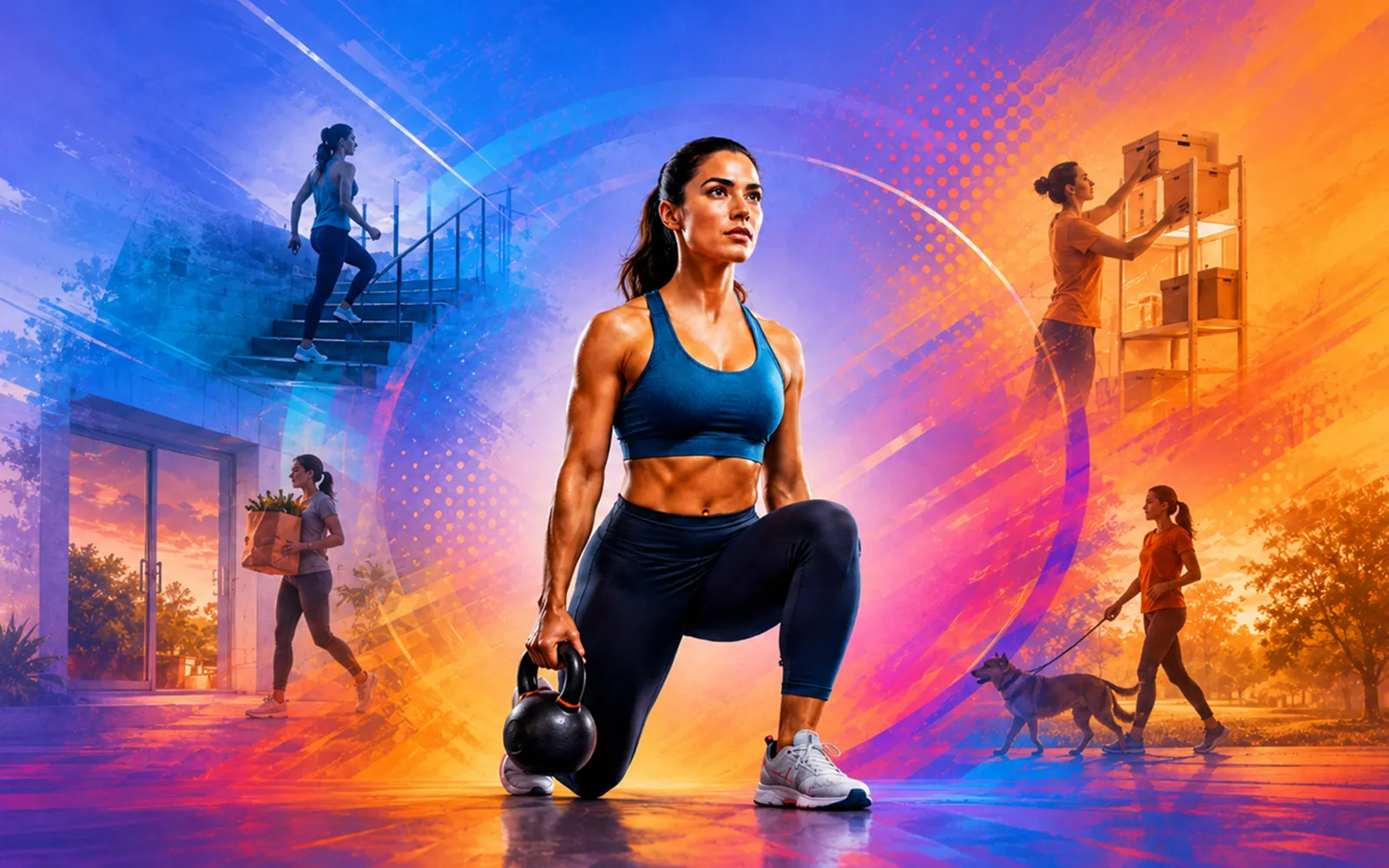

Independence is built from surprisingly ordinary movements.
Standing up from a chair. Walking across a parking lot. Climbing a flight of stairs. Carrying groceries into the house. Stepping off a curb. Getting up from the floor. Moving a box. Maintaining balance when the ground is uneven.
We rarely think about the muscular demands of these activities when they are easy.
That changes when they become difficult.
The muscles of the hips, thighs, and lower legs provide much of the force that allows us to lift and move our own body weight through the world. When sufficient strength is available, daily movement can feel almost effortless. When that reserve becomes smaller, ordinary tasks begin consuming a much larger percentage of our physical capacity.
This is why strong legs matter for far more than exercise performance.
They help create a physical reserve between what everyday life requires and what the body is capable of producing.
That reserve can make the difference between merely being able to perform a task and performing it comfortably, repeatedly, and confidently.
Your Legs Do Much More Than Move You Forward
The lower body is not one muscle group.
Everyday movement depends on coordinated contributions from muscles surrounding the hips, knees, ankles, and feet.
The quadriceps at the front of the thighs extend the knees and contribute strongly when we stand, climb, and control our descent.
The gluteal muscles help extend and stabilize the hips.
The hamstrings assist hip extension and knee flexion.
The calf muscles contribute to propulsion during walking and help control the ankle.
Smaller muscles around the hips and lower legs help stabilize the pelvis, knees, ankles, and feet as body weight shifts from one leg to the other.
These muscles rarely operate independently in real life.
Standing from a chair combines motion at the hips, knees, and ankles while the trunk moves forward and the body’s center of mass shifts over the feet. Walking repeatedly transfers body weight from one leg to the other. Stair climbing requires one leg to help elevate nearly the entire body against gravity.
The lower body is therefore not simply an engine for locomotion.
It is also part of the support system that lets us control our own body weight.
Strength Creates Reserve
Suppose standing from a chair requires a certain amount of force.
If that task demands only a modest portion of your available strength, you have considerable reserve.
You can probably stand more quickly, repeat the movement several times, rise from a somewhat lower surface, or manage the task while carrying something.
Now imagine that the same chair rise requires nearly everything your legs can produce.
The movement may still be possible.
But there is very little capacity left over.
This concept helps explain why muscle weakness can become important before a person completely loses the ability to perform a task.
Longitudinal research involving older adults has consistently linked lower muscle strength and poorer physical performance with a greater likelihood of later difficulty in activities of daily living. A systematic review and meta-analysis encompassing more than 100,000 older adults found that measures of low strength and poor physical performance predicted subsequent dependence in everyday activities.
The relationship is not perfectly simple. Function also depends on balance, joint health, coordination, cardiovascular capacity, sensory function, cognition, pain, and many other factors.
But strength provides something fundamental:
room to work with.
The Chair Rise Is a Small Movement With a Big Meaning
Few movements illustrate lower-body function as clearly as standing from a chair.
We perform it throughout the day without thinking about it.
Yet rising requires the body to move its center of mass forward and upward while the muscles around the hips, knees, ankles, and trunk coordinate force and balance.
This is why chair-rise tests appear so often in research and clinical assessment.
The 30-second chair-stand test, for example, has demonstrated a strong relationship with lower-body strength in community-dwelling older adults and has become a widely used functional assessment.
Biomechanical research also shows that aging can change how people accomplish the movement. A 2023 systematic review found that older adults generally took longer to rise and showed differences in trunk movement, muscle co-activation, force development, and balance control compared with younger adults.
That does not mean difficulty standing is simply a quadriceps problem.
But the movement illustrates an important principle:
Everyday independence depends not only on whether the body can generate force, but on whether enough force is available for the task without using nearly everything in reserve.
“Strong legs create more than force. They create reserve—the extra physical capacity that can make ordinary movements easier today and help preserve more choices about how we move through life tomorrow.”
Stairs Reveal How Demanding Daily Life Can Be
A staircase can expose lower-body limitations long before level walking does.
Walking on flat ground allows momentum and repeated rhythmic motion to assist us.
Stairs require considerably more vertical work.
During ascent, the legs must raise body mass against gravity. During descent, they must control the body as gravity pulls it downward.
Research measuring the biomechanics of stair negotiation in adults between 60 and 88 years of age found particularly high demands on the knee extensors, demonstrating how close some everyday movements can come to the available muscular capacity of older adults.
This helps explain a common experience.
Someone may still be able to walk comfortably through a store yet notice that stairs have become disproportionately difficult.
The problem is not necessarily endurance alone.
The strength reserve required by the task may be shrinking.
Adding strength does not change the staircase.
It changes the percentage of your capacity the staircase requires.
Walking Is More Than Repeated Steps
Walking may seem less strength-dependent because no single step usually feels difficult.
But the legs must repeatedly support body weight, control joints, propel the body forward, and respond to changes in terrain.
When strength becomes limited, walking may slow and mobility can become more demanding.
A 2022 systematic review and meta-analysis of resistance-training trials in community-dwelling older adults with mobility limitations found improvements in lower-extremity strength, usual walking speed, and six-minute walking distance compared with control conditions.
A much larger 2026 meta-analysis incorporating 92 studies and almost 6,000 older adults likewise found substantial improvements in strength and more moderate improvements across several gait-related and functional outcomes following resistance training. Importantly, when resistance training was compared with other active forms of exercise rather than passive controls, its advantage was smaller for many measures.
That qualification is useful.
Strength training can support walking capacity.
But walking is not simply a leg-strength test.
Aerobic fitness, balance, gait mechanics, mobility, confidence, neurological function, and habitual activity all contribute.
Strength and Power Work Together
In our previous article on muscle power, we explored an important distinction.
Strength describes how much force can be produced.
Power incorporates how quickly that force can be expressed.
The two qualities are closely related, but they are not interchangeable.
Getting out of a chair requires enough strength to lift the body.
Doing it briskly requires power as well.
Recovering from a sudden loss of balance may require force to be produced quickly.
Carrying a heavy object may depend more strongly on force capacity.
A capable lower body therefore benefits from both.
Strong legs create the underlying force reserve.
Power helps make that force available rapidly when the situation demands it.
This is one reason fitness later in life should not be reduced to any single physical quality.
Strong Legs Are Not Necessarily Big Legs
Muscle size and muscle strength are related.
But they are not identical.
Muscle strength depends on the amount and quality of muscle tissue, neural activation, coordination, technique, leverage, training history, and other factors.
Someone can become stronger without producing dramatic visible changes in leg size.
Likewise, measuring muscle mass alone does not tell us exactly how well that muscle performs.
This distinction becomes particularly relevant with aging because researchers increasingly separate muscle quantity from muscle function.
A 2024 systematic review and meta-analysis found that resistance training in adults age 65 and older significantly increased lower-extremity muscle size and muscle-fiber area.
A much larger 2025 network meta-analysis involving 151 randomized trials found that supervised resistance training improved lower-body strength and physical function across older populations, although the amount of training associated with the largest gains differed depending on whether the outcome was strength, muscle size, or functional performance.
The practical message is simple:
You do not need visibly muscular thighs to benefit from stronger legs.
Function matters more than appearance.
Age Does Not Make Strength Training Irrelevant
Muscle strength commonly declines with advancing age, particularly when physical activity and resistance loading decrease.
But decline is not the same as inability to adapt.
Older muscle remains responsive to training.
The National Strength and Conditioning Association’s position statement on resistance exercise for older adults concludes that progressive resistance training can counter losses in muscle mass and strength and improve mobility, physical functioning, and the ability to maintain independence.
More recent evidence continues to support that conclusion.
The 2025 network meta-analysis mentioned above included more than 6,000 adults age 60 and older and found meaningful improvements in lower-limb strength across resistance-training volumes.
Even simple resistance modalities may be effective. A 2025 meta-analysis of 25 randomized trials found that elastic-band training improved measures including leg-extension strength, chair-standing ability, timed mobility, and balance in older adults, although effects varied substantially between studies.
The body does not stop responding simply because the calendar advances.
Training does, however, need to match the person’s health, experience, mobility, and starting ability.
Independence Requires Strength in More Than One Direction
Daily life does not happen on a leg-extension machine.
We rise vertically.
Walk forward.
Step sideways.
Turn.
Carry uneven loads.
Climb.
Lower ourselves.
Reach while standing.
Recover when our balance shifts.
This means lower-body capability depends on more than maximizing one measurement of strength.
A well-rounded approach generally needs to challenge several basic movement functions:
- Hip and knee extension for rising, climbing, lifting, and pushing the body upward.
- Hip stability for controlling the pelvis when body weight shifts onto one leg.
- Knee control for standing, stepping, ascending, and lowering the body.
- Ankle and calf strength for propulsion, balance, and control during walking.
- Single-leg capacity because walking, stairs, curbs, and many balance corrections repeatedly place more demand on one side at a time.
- Strength through useful ranges of motion so muscular capacity remains available in the positions daily life actually requires.
This does not mean everyone needs a complex exercise program targeting every muscle separately.
Many multi-joint movements train several of these functions simultaneously.
The broader point is to think about what the legs need to accomplish, not merely which muscle is being exercised.
Both Legs Need to Be Able to Contribute
Human beings are not perfectly symmetrical.
Almost everyone has a preferred side.
Small strength differences between legs are common.
But substantial differences can alter how movement is performed.
A stronger side may begin doing more of the work when standing, climbing, or lifting. That compensation may allow the task to continue, but it can also conceal weakness on the other side.
This is one reason movements that require each leg to contribute independently can provide information that bilateral movements sometimes hide.
Walking already demands repeated single-leg support.
So do stairs.
So does stepping over an obstacle.
Lower-body training does not need to pursue perfect symmetry, but maintaining useful capacity on both sides supports more movement options.
Walking Is Valuable—but It Is Not the Same as Strength Training
Walking is one of the most accessible and useful forms of physical activity.
It develops endurance, maintains mobility, provides repeated weight-bearing movement, and carries broad health benefits.
But ordinary walking may not provide enough resistance to continue increasing lower-body strength once the muscles are accustomed to it.
This distinction matters because someone can be active and still benefit from dedicated strengthening.
The World Health Organization recommends that adults perform muscle-strengthening activities involving the major muscle groups on at least two days each week. For older adults, WHO additionally recommends multicomponent activity emphasizing functional balance and strength on three or more days per week to support functional capacity and reduce fall risk.
Walking and resistance training therefore do not need to compete.
They train overlapping but different aspects of physical capability.
The Body Needs a Reason to Remain Strong
Muscle adapts to demand.
When tasks repeatedly require meaningful force, the neuromuscular system receives a reason to maintain or increase its capacity.
When those demands disappear, maintaining excess strength becomes less biologically necessary.
This is why progressive resistance matters.
A challenge that once required considerable effort eventually becomes familiar.
To keep producing adaptation, resistance training typically needs some form of progression—more resistance, more repetitions, greater movement difficulty, additional volume, or another appropriate increase in demand.
Progression does not mean constantly chasing heavier weights.
It means preventing the body from spending years solving exactly the same easy problem.
For someone beginning with limited strength, even body-weight movements or light external resistance may provide a meaningful stimulus.
As capacity improves, the challenge can evolve.
Stronger Legs Can Make Life Feel Lighter
One of the most practical benefits of building strength is not that daily objects literally become lighter.
Your relationship to them changes.
A grocery bag weighing 15 pounds still weighs 15 pounds.
A staircase still has the same number of steps.
Your body still weighs what it weighs.
But if your capacity has increased, those demands represent a smaller fraction of what you can do.
This is the value of reserve.
It gives everyday life more margin.
More margin can mean standing up without using the arms.
Carrying something without needing to stop.
Taking stairs without approaching maximal effort.
Walking farther before muscular fatigue becomes limiting.
Handling an unexpected physical demand with greater confidence.
That is a very different fitness goal from simply improving a number in the gym.
The gym—or whatever form resistance training takes—is the preparation.
Life is where the reserve gets used.
Strength Does Not Guarantee Independence
Strong legs are important.
They are not sufficient by themselves.
Everyday independence also depends on balance, mobility, vision, cognition, cardiovascular fitness, joint health, neurological function, confidence, pain, the surrounding environment, and many other factors.
Chronic disease or disability can alter what independence looks like for different people.
This is why claims such as “strong legs prevent falls” or “strength training keeps everyone independent” go too far.
The evidence supports a more useful conclusion:
Lower-body strength is one modifiable component of physical function.
And unlike many factors that affect aging, it is something we can actively train.
Train for the Life You Want to Keep Doing
Fitness is often measured in numbers.
Weight lifted.
Distance covered.
Repetitions completed.
Those measurements are useful because they show progress.
But beneath them is a more meaningful question:
What do you want your body to remain able to do?
Stand from the floor?
Carry your own luggage?
Walk through an airport?
Climb stairs?
Work in the garden?
Travel?
Play with grandchildren?
Continue living comfortably in a multistory home?
Move confidently through the community?
Lower-body strength supports many of these possibilities.
It does not guarantee them.
But it increases the physical capacity available to meet their demands.
And that may be one of the most useful ways to think about strength training across the lifespan.
Not as an attempt to build the strongest possible legs.
Not as a pursuit of a particular appearance.
But as an investment in physical options.
Strong legs create more than force. They create reserve—the extra physical capacity that can make ordinary movements easier today and help preserve more choices about how we move through life tomorrow.
That is why lower-body strength matters.
The objective is not simply to become stronger.
It is to remain capable.
Medical and Exercise Disclaimer
This article is intended for general educational purposes and is not individualized medical, rehabilitation, or exercise advice. People who are new to resistance training or who have significant cardiovascular, neurological, balance, joint, musculoskeletal, or other medical conditions should seek appropriate professional guidance before beginning or substantially changing an exercise program. Exercise selection, resistance, range of motion, and progression should be matched to individual ability and health status.
You Might Also Like
Potential HIV Vaccine Falls Short in Mid-stage Study
Medicaid Expansion Improves Hypertension and Diabetes Control
Long-Term Care Needs Among Retirees Varies Widely, New Research Shows
Benefits of Yoga: 10 Ways Your Practice Can Improve Your Life
What Are Some Ways to Prevent the Spread of COVID-19?