














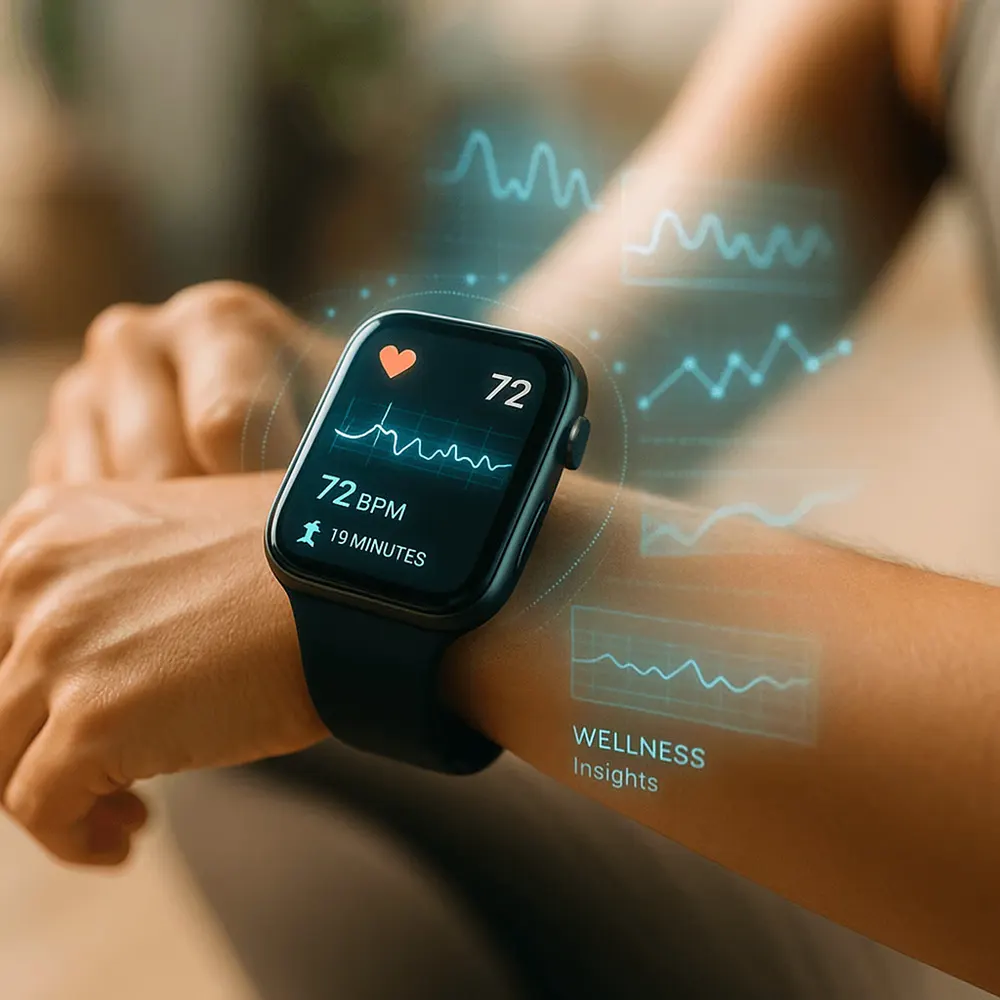
Your wearable vibrates in the middle of an ordinary afternoon.
High stress.
You look at the screen.
Nothing dramatic is happening.
You are not arguing with anyone. You are not frightened. You do not even feel especially anxious.
Perhaps you just finished climbing a flight of stairs. Maybe you drank coffee an hour ago. You slept poorly last night. You are coming down with a cold. You have been concentrating intensely for forty minutes.
Or perhaps the device has noticed something before you have.
This is both the promise and the problem of wearable stress tracking.
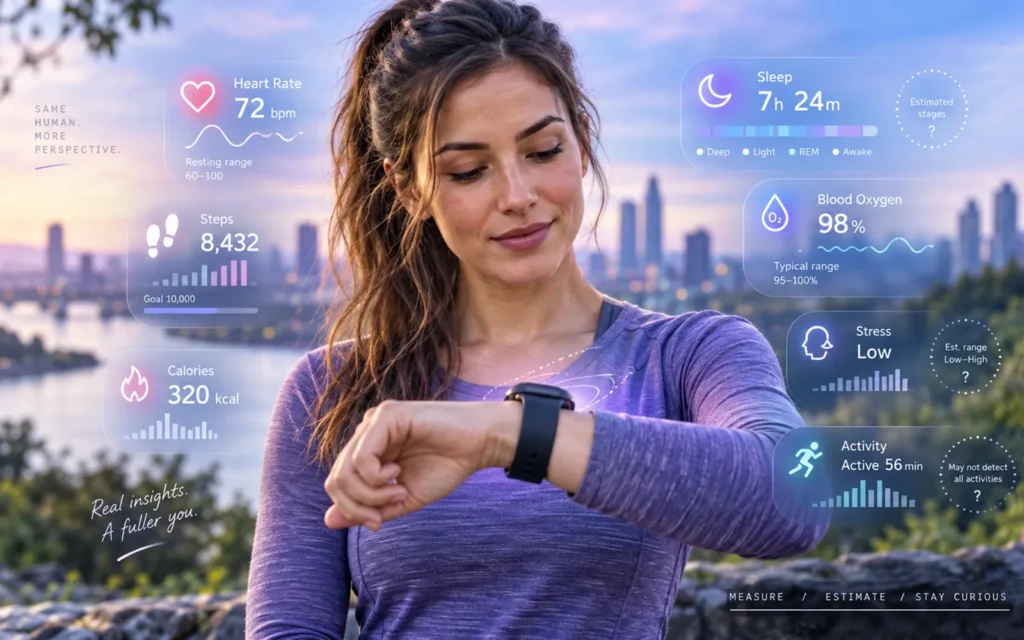
Modern smartwatches, smart rings, and fitness trackers can continuously observe aspects of physiology that would have been impractical to monitor outside a laboratory only a few decades ago. They can follow heart rate, movement, sleep-wake patterns, skin temperature, variations between heartbeats, and—in some devices—electrodermal activity, blood oxygen estimates, electrical cardiac signals, and other measurements.
What they cannot do is look directly into the mind and determine:
This person is stressed.
Instead, the device observes body signals associated with physiological arousal, processes them through algorithms, compares them with patterns or personal baselines, and produces an interpretation.
Sometimes that interpretation may be useful.
Sometimes it may be misleading.
And understanding the difference begins with recognizing that stress is not one thing a sensor can directly measure.
Stress Leaves Clues, Not a Single Signature
Psychological stress can affect many systems at once.
Heart rate may rise.
The intervals between heartbeats may change.
Breathing can become faster or shallower.
Sweat-gland activity can increase.
Peripheral temperature may shift.
Sleep may change.
Movement patterns can change.
Some people become restless; others become unusually still.
Because these physiological responses accompany stress, they give wearable technology something to detect.
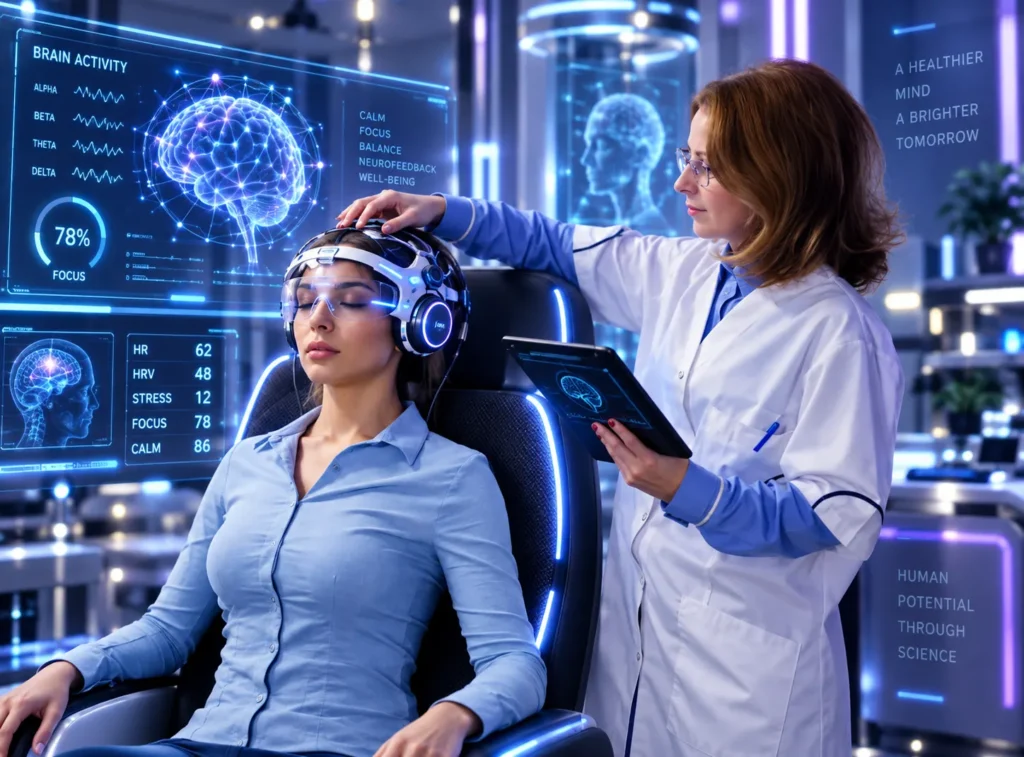
Research into wearable stress recognition commonly uses signals such as photoplethysmography, or PPG, heart-rate variability, electrodermal activity, respiratory patterns, movement, and sleep-related information. Recent systematic reviews show that multimodal approaches—combining more than one physiological signal—are increasingly common because no single sensor captures the entire stress response.
But those signals are not unique to stress.
A faster heart rate may reflect exercise.
Lower HRV may accompany poor sleep, illness, alcohol use, physical fatigue, or other influences.
Sweat-gland activity can increase because of emotional arousal, concentration, heat, or exertion.
Skin temperature changes with environment and circulation.
This creates the central challenge of wearable stress tracking:
The body can reveal that something has changed without revealing exactly what that change means.
“The wearable is often best at recognizing that your body has changed. You are still needed to understand what that change means.”
How a Stress Score Is Made
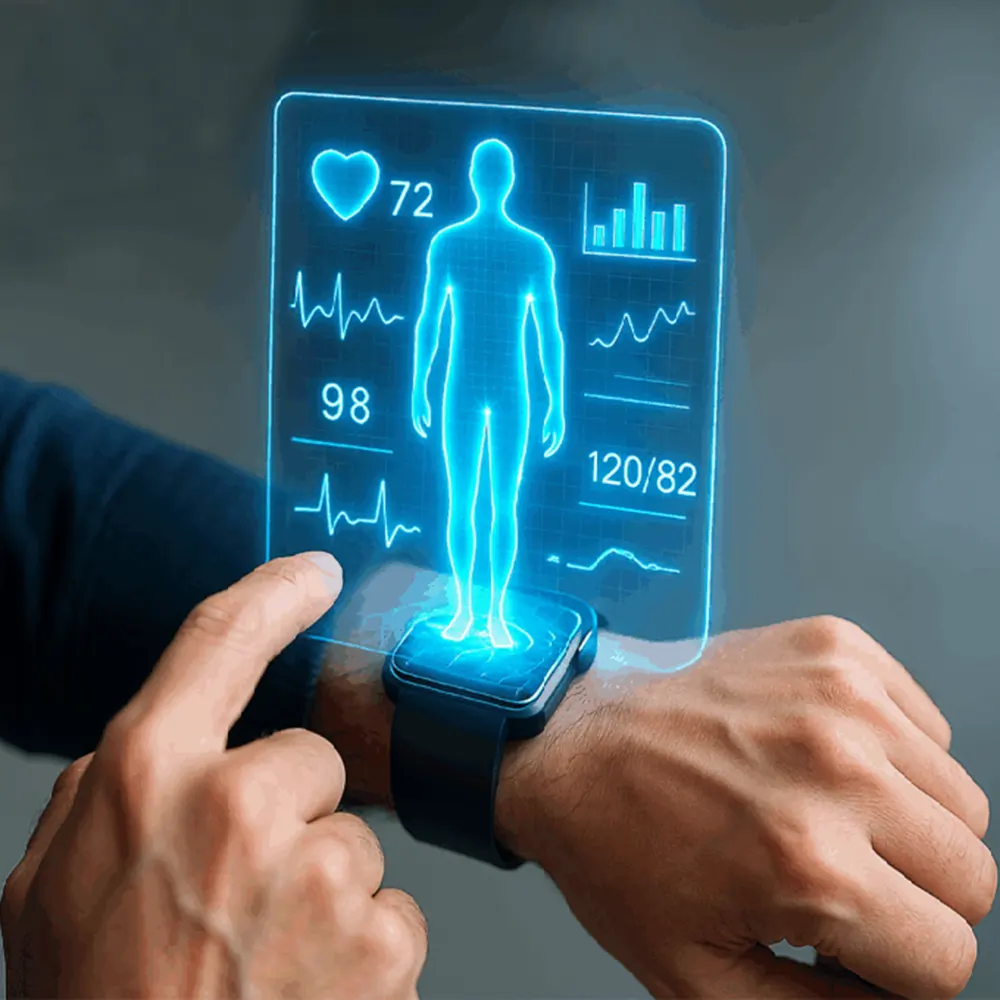
A stress score may look like a simple number—perhaps 22, 64, or 87.
What sits underneath it can be much more complicated.
First, sensors collect physiological signals.
A PPG sensor may track pulse-related changes in blood volume. An accelerometer records movement. A temperature sensor follows changes near the skin. Some devices measure electrodermal activity. Other information may come from sleep, activity, respiratory estimates, or resting heart-rate patterns.
Software then extracts features from those signals.
Instead of using only the raw pulse waveform, for example, an algorithm may calculate heart rate or variations in beat timing. Movement data may be used to decide whether cardiovascular changes occurred while someone was exercising or sitting quietly.
The system may then compare the pattern with:
your own previous values,
population-derived models,
known activity patterns,
or machine-learning classifications developed using labeled stress data.
Finally, the manufacturer converts those calculations into a consumer-friendly output.
Stress: 72.
The important distinction is that the sensor never measured 72 units of stress.
The number represents an algorithmic interpretation of several measurements and assumptions.
Heart Rate Variability Is Useful—but It Is Not a Stress Meter
Heart-rate variability, or HRV, has become central to many wellness wearables.
HRV describes variation in the time intervals between consecutive heartbeats.
Those intervals are influenced by autonomic regulation and respond to respiration, activity, recovery, sleep, illness, alcohol, training, medications, age, and many other factors.
Stress can influence HRV.
That makes HRV useful.
It does not make HRV a direct measurement of psychological stress.
This distinction becomes especially important because optical wearables usually obtain beat-to-beat information through PPG rather than an electrocardiogram. PPG-derived heart rate is often quite accurate under favorable conditions, while estimates of beat-to-beat variability become more vulnerable to movement and signal noise. Recent research comparing optical wearables with ECG has found better agreement for heart rate than for HRV, particularly once people begin moving.
This is one reason many devices place greater emphasis on HRV recorded during sleep or quiet periods.
The body is moving less.
Sensor contact is more stable.
The physiological signal is easier to isolate.
Why the Finger and Wrist Are Not Equivalent
Where a wearable sits on the body matters.
Most smartwatches and fitness bands measure optical signals at the wrist.
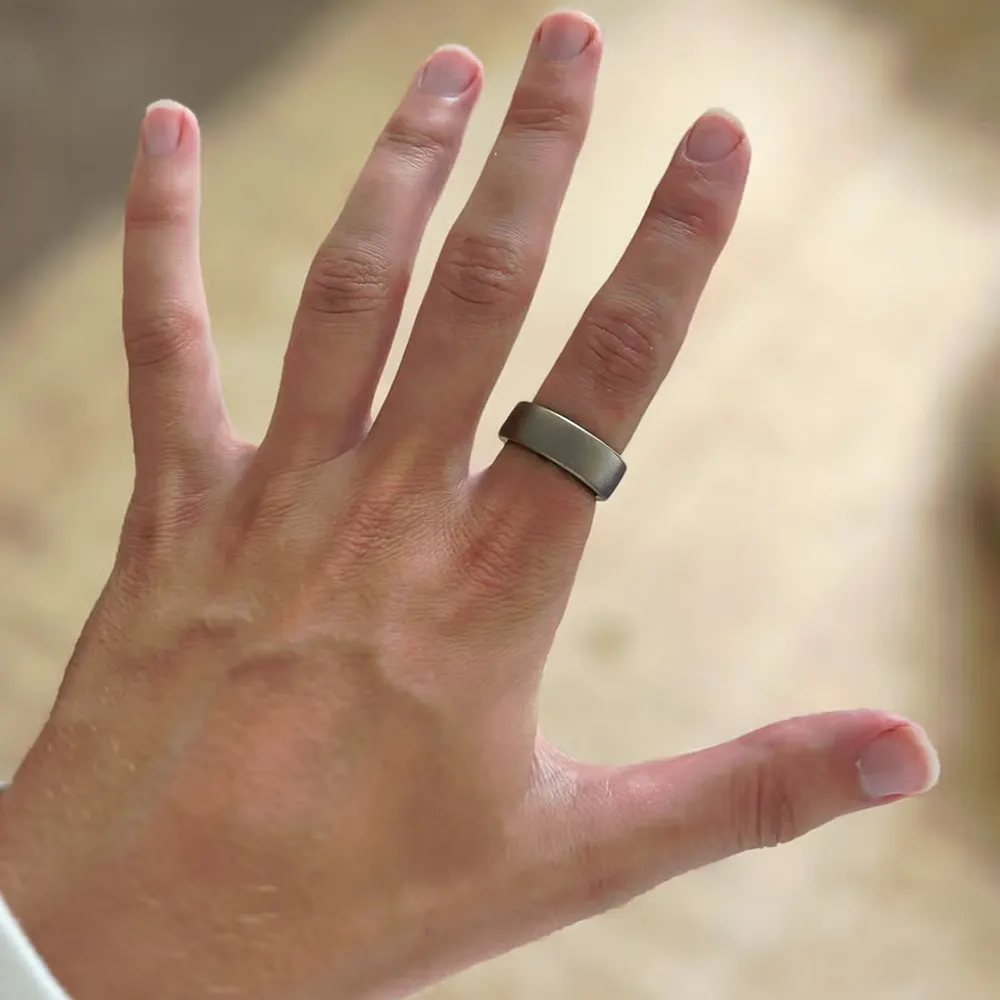
Smart rings measure from the finger.
That difference is not merely cosmetic.
The finger has a rich peripheral blood supply and can provide favorable conditions for optical pulse sensing. A 2026 study comparing reflective PPG signals across several body locations found the finger produced the strongest overall signal quality among the sites tested, while the wrist was among the most challenging.
That does not automatically mean every ring is more accurate than every watch.
Sensor quality, fit, LEDs, photodetectors, software, motion correction, sampling methods, and algorithms all matter.
But the location helps explain why rings can perform well for quiet cardiovascular measurements and overnight monitoring.
A 2025 systematic review of smart-ring research covering 107 studies found strong performance for heart rate and HRV in the studied devices and substantial research devoted to sleep and continuous physiological monitoring. The authors also emphasized that clinical utility beyond established monitoring applications remains an evolving area.
The wrist has different advantages.
There is more room for batteries, displays, antennas, GPS, multiple sensors, controls, and processors.
That makes the smartwatch far more versatile even if the finger offers some sensing advantages for certain optical measurements.
Different form factors solve different problems.
Smart Rings: Quiet Observation Is Their Strength
Smart rings tend to make the most sense when passive, continuous monitoring is the priority.
They are particularly well suited to collecting information while the user is doing nothing with the device.
There is usually no screen demanding attention.
The device can simply remain on the finger while the person sleeps, works, walks, or goes about daily life.
For this reason, rings have become especially associated with:
- overnight heart rate and HRV trends
- sleep and recovery monitoring
- resting physiological patterns
- skin-temperature trends
- long-duration passive data collection
This makes the ring a natural platform for algorithms attempting to identify changes in recovery or physiological strain.
Its greatest strength is often continuity rather than interaction.
That can also be a limitation.
A ring is generally less suited to displaying detailed live workout information, mapping a run, navigating with GPS, showing messages, or presenting complex information directly on the device.
And activities involving substantial hand movement, gripping, or external pressure against the ring can create practical or measurement challenges.
The ring therefore excels most when you want technology to observe quietly in the background.
Smartwatches: The Broadest Toolset
The smartwatch takes almost the opposite approach.
It is not merely a sensor.
It is also an interface.
The display allows the device to provide immediate feedback while exercise or another activity is taking place. Integrated GPS can track routes, pace, and distance. Accelerometers and gyroscopes classify movement. Optical sensors monitor cardiovascular signals. Some watches incorporate ECG capability, temperature sensing, oxygen-related measurements, or other features.
This makes the smartwatch especially useful for:
- exercise monitoring,
- live heart-rate feedback,
- GPS-based activities,
- activity recognition,
- timers and pacing,
- interactive coaching,
- notifications,
- and immediate access to health information.
Recent reviews continue to find heart rate among the better validated smartwatch measurements, although accuracy varies substantially by activity, device, population, and measurement conditions. Higher-level outputs such as energy expenditure, sleep staging, fitness estimates, and readiness scores involve considerably more inference.
The smartwatch therefore offers breadth.
It may not always be the ideal sensor for every individual physiological signal, but it can bring many sensing, communication, navigation, and feedback functions together in one device.
Fitness Trackers: Simplicity Can Be an Advantage
Fitness trackers and smart bands occupy a somewhat fluid middle ground.
The boundary between a fitness tracker and a smartwatch has become increasingly blurry. Some bands now contain sophisticated optical sensors, color displays, sleep tracking, blood-oxygen estimates, and smartphone integrations.
But their traditional strength remains straightforward activity monitoring.
Steps.
Movement.
Active minutes.
Exercise sessions.
Heart rate.
Basic sleep information.
That apparent simplicity should not be dismissed.
A 2026 systematic review of wrist-worn activity trackers found that modern devices have improved substantially in heart-rate and step-count accuracy compared with earlier generations. Steady-state walking step counts in newer devices often showed errors below about 5 percent, while energy-expenditure estimation remained much less reliable.
For someone whose main question is:
Am I moving enough?
a simple tracker may provide everything necessary.
Adding ten additional physiological scores does not necessarily improve the answer.
This illustrates one of the most important principles in wellness technology:
More sensors are valuable only when they provide information you can meaningfully use.
A Wearable Can Be Excellent at One Thing and Mediocre at Another
One of the easiest mistakes in wearable technology is to think in terms of an “accurate device.”
Accuracy belongs to a measurement, not automatically to the entire device.
A smartwatch might provide excellent heart-rate measurements and relatively poor estimates of calories burned.
The same device may perform well at detecting sleep versus wake but be less reliable when dividing sleep into stages.
It may count ordinary walking accurately but perform differently during slow movement or unusual activities.
A major 2024 umbrella review examined 24 systematic reviews encompassing 249 unique wearable-validation studies and more than 430,000 participants. Heart-rate measurements generally performed comparatively well, while substantial variability remained across activity intensity, energy expenditure, sleep, oxygen saturation, step counting, and VO₂-max estimates. The review also found that only a small fraction of commercially available device-and-metric combinations had undergone comprehensive independent validation.
This means the right question is rarely: Is this watch accurate?
The right question is: How accurate is this particular measurement, on this device, under these conditions?
Stress Scores Add Yet Another Layer of Interpretation
Stress is more difficult still because there is no laboratory instrument that produces one universally accepted numerical stress value against which every consumer device can simply be calibrated.
Researchers must first decide what they mean by stress.
Sometimes it is a controlled laboratory challenge.
Sometimes participants report how stressed they feel.
Sometimes questionnaires are used.
Sometimes investigators attempt to classify episodes using physiological patterns.
Those labels then become the targets for wearable algorithms.
A 2025 systematic review of machine-learning stress prediction found frequent use of HRV, electrodermal activity, PPG, respiratory information, and other physiological signals. The review also identified major challenges involving dataset size, sensor differences, real-world validity, and whether models developed in one population or setting continue working reliably in another.
A recent study testing stress models across different consumer and research-grade sensors demonstrated the same problem: models could perform well within one device or dataset yet lose accuracy when transferred to different hardware or conditions.
This is a fundamental machine-learning problem.
Recognizing stress in the same laboratory where the algorithm was developed is one thing.
Recognizing your stress on an ordinary Tuesday afternoon is a much harder challenge.
Electrodermal Activity Adds Information—but Still Not Meaning
Some wearables include electrodermal activity, or EDA.
EDA measures changes in the electrical conductance of the skin associated primarily with sweat-gland activity under sympathetic nervous-system control.
That makes it sensitive to physiological arousal.
Researchers have used it extensively in stress-detection experiments, and recent reviews show EDA to be one of the most commonly studied wearable signals for stress classification.
But EDA has the same fundamental limitation as heart rate.
It measures an aspect of arousal, not the meaning of the arousal.
A surprise can increase it.
So can anticipation.
Mental effort.
Excitement.
Fear.
Heat.
This is why combining EDA with heart information, movement, contextual data, or self-report can improve interpretation.
More sensors provide the algorithm with more clues.
They do not make the device omniscient.
Your Baseline May Matter More Than Someone Else’s Number
Wearable technology becomes more interesting when it stops asking whether your physiology is “normal” in the abstract and begins asking whether it is normal for you.
Resting heart rate varies substantially between people.
So does HRV.
Sleep patterns differ.
Responses to exercise differ.
Stress physiology differs.
This makes within-person trends especially valuable.
Perhaps your overnight HRV is consistently within one range, then declines noticeably for several days.
Your resting heart rate rises at the same time.
Sleep becomes shorter.
Skin temperature shifts.
One measurement alone may be ambiguous.
Together, compared with your usual pattern, they may provide useful evidence that something about your physiological state has changed.
That still does not reveal the cause.
But it can prompt a better question:
What has been different lately?
Illness?
Training?
Sleep?
Alcohol?
Travel?
Emotional strain?
Medication?
A wearable becomes most useful when its data begins a process of interpretation rather than ending one.
Why Two Devices Can Disagree About Your Stress
Imagine wearing two different devices simultaneously.
One says your stress is low.
The other says it is elevated.
That can seem like proof that one must be wrong.
Not necessarily.
The devices may measure different signals.
One may emphasize HRV.
Another may incorporate heart rate, movement, temperature, sleep, or EDA.
They may average information over different periods.
They may establish personal baselines differently.
One may remove exercise periods from its stress calculation while another handles them differently.
The manufacturers may also define the word stress differently.
This creates a crucial point that applies to almost every proprietary wellness score:
A stress score from one ecosystem is not necessarily the same quantity as a stress score from another.
There is no universal scale comparable to degrees Fahrenheit or beats per minute.
The number gains its meaning from the algorithm that produced it.
Physiological Stress and Emotional Stress Can Separate
Perhaps the most interesting wearable moment occurs when the device and your subjective experience disagree.
Your watch says stress is elevated.
You feel fine.
Should you believe your body or your technology?
That is the wrong choice to force.
Both pieces of information may matter.
Perhaps your body is still recovering from poor sleep or hard exercise even though you feel emotionally calm.
Perhaps you are concentrating intensely.
Perhaps your physiology has changed for a reason unrelated to psychological stress.
Or perhaps you have become accustomed to a level of tension that the device is detecting before you consciously label it as stress.
The opposite can occur as well.
You may feel deeply worried while the particular signals used by your device change very little.
Stress is both physiological and psychological, but the two dimensions do not always move in perfect synchrony.
A 2026 systematic review examining wearable digital biomarkers and anxiety found that some physiological and behavioral measures were associated with anxiety, but predictive performance varied and wearable data appeared more useful when combined with other sources of information rather than treated as a stand-alone assessment.
That is a useful model for stress tracking too.
The wearable contributes evidence.
You contribute experience and context.
Neither should automatically erase the other.
When a Stress Score Is Actually Helpful
A wearable stress score is most useful when it changes the quality of attention rather than simply creating another number to monitor.
You notice elevated readings most afternoons.
Then you notice those are the hours when you schedule meetings back-to-back without breaks.
Perhaps you discover that stress readings remain elevated after late-night alcohol.
Or that they improve during walks.
Or that several nights of poor sleep consistently precede higher daytime physiological arousal.
The score has not diagnosed anything.
It has helped reveal a pattern.
This is where Wellness Tech can overlap constructively with Mental Wellness.
The device may encourage a moment of self-observation:
What am I feeling right now?
How am I breathing?
Have I been sitting tense for an hour?
Did I sleep poorly?
Am I actually distressed—or simply physiologically activated?
Do I need a break, movement, food, recovery, conversation, or nothing at all?
A good stress feature should make those questions easier to ask.
It should not pretend to answer all of them.
When Tracking Starts Replacing Self-Awareness
Wearables can create an odd reversal.
Originally, the technology exists to help us understand ourselves.
Eventually, some people begin checking the technology to discover how they are allowed to feel.
My recovery score is poor, so I must be tired.
The watch says I’m stressed, so something must be wrong.
My HRV fell, so today will be bad.
That is not an inevitable consequence of tracking, but it is a useful boundary to recognize.
Numbers can add perspective.
They should not automatically overrule lived experience.
Wearable-based interventions do appear capable of changing behavior in useful ways. A 2026 umbrella review found reasonably consistent evidence that interventions incorporating wrist-worn trackers can increase physical activity, although effects on broader outcomes such as anxiety, depression, quality of life, and other health measures remain less consistent.
This distinction reinforces a larger principle:
Feedback is most valuable when it helps us act intelligently—not when it makes us dependent on feedback.
Match the Device to the Question
There is no single “best wearable” because different devices prioritize different jobs.
If you are choosing what kind of information matters, a useful way to think about the categories is:
- Choose the smart-ring approach when passive, overnight, and longitudinal physiological trends matter most. Rings are particularly well suited to quiet heart-rate and HRV measurement, temperature trends, sleep monitoring, and continuous background collection.
- Choose the smartwatch approach when you want the broadest combination of physiology, activity, GPS, workouts, interactive feedback, and on-device features. It is generally the most versatile format.
- Choose the fitness-tracker approach when movement, steps, activity goals, basic cardiovascular tracking, simplicity, and lower-friction monitoring are the priorities. A simpler device may be more useful when the question itself is simple.
- Do not choose any consumer wearable because you expect it to directly read your psychological state. Stress and mental well-being are inferred from physiological and behavioral clues, not measured as a single biological quantity.
The best technology is the one whose strengths match the question you actually want answered.
Consumer Wellness Data Is Not Automatically Medical Data
The distinction becomes especially important when a wearable moves from general wellness into medically consequential interpretation.
In January 2026, the FDA updated its guidance covering low-risk general-wellness products. The guidance distinguishes products intended to encourage healthy lifestyles from functions intended for diagnosis, treatment, mitigation, or other medical purposes.
A device displaying a wellness-oriented stress or recovery trend is therefore not necessarily performing the same type of function as a regulated medical device.
And the same wearable may contain different features with different regulatory status.
A watch may provide a general-wellness sleep score alongside a separately regulated ECG-related function.
The fact that both appear on the same screen does not mean they have undergone the same type of validation.
This is especially important when a reading might influence medical decisions.
A stress score should not be used to diagnose an anxiety disorder.
A recovery score should not determine whether concerning symptoms are medically important.
And a reassuring wearable reading should never be used to dismiss symptoms that warrant professional evaluation.
The Score Is a Question, Not a Verdict
Wearables are becoming remarkably good at observing us.
The ring notices physiological changes while we sleep.
The watch follows us through exercise.
The fitness tracker quietly counts the accumulated movement of ordinary life.
All three can reveal patterns that human memory would struggle to reconstruct accurately.
That is valuable.
But the closer the technology moves toward complex concepts such as stress, recovery, readiness, and well-being, the farther it moves from direct sensing and the more interpretation enters the process.
That should not make us distrust the technology.
It should make us understand it better.
A stress score can be useful without being literal.
A sleep estimate can reveal trends without being a sleep laboratory.
A recovery metric can organize several physiological signals without knowing exactly how recovered you feel.
And different wearable formats can each be excellent tools without one being universally superior.
The wearable is often best at recognizing that your body has changed. You are still needed to understand what that change means.
Perhaps that is the healthiest relationship we can have with wellness technology.
Let the ring observe.
Let the watch measure.
Let the tracker count.
Let the algorithm look for patterns.
Then bring something the device does not possess:
context, judgment, experience, and an understanding of the life in which those numbers occurred.
Health and Mental Wellness Disclaimer
This article is intended for general educational purposes and is not medical or mental-health advice, diagnosis, or treatment. Consumer wearable stress, recovery, readiness, sleep, HRV, and related scores vary by device, sensor, algorithm, and intended use and should not be considered direct measurements of psychological stress or mental-health conditions. Persistent anxiety, severe stress, sleep problems, significant mood changes, or symptoms that interfere with daily functioning should be discussed with an appropriately qualified healthcare or mental-health professional. Concerning physical symptoms should not be dismissed or diagnosed on the basis of a wearable reading.